
Interview questions · Part 1
Top 50 JavaScript Interview Questions with Answers (Free PDF)
By Gaurav SharmaPublished
49 pages covering the 50 most-asked JavaScript interview questions, each with a short answer to say first and a detailed explanation: var/let/const, hoisting, closures, this, the event loop and output puzzles, promises and async/await, plus coding answers for debounce, throttle, deep clone, Promise.all, bind, curry, memoize and an LRU cache, with Hinglish explanations.
- Pages
- 49
- Format
- A4 PDF
- Language
- English + Hinglish
- Price
- Free by email
What's inside
Preview: 5 of 50 JavaScript interview questions
Read a sample of the questions and answers here. Email me for the complete PDF with detailed explanations, code, outputs, traps and follow-up questions.
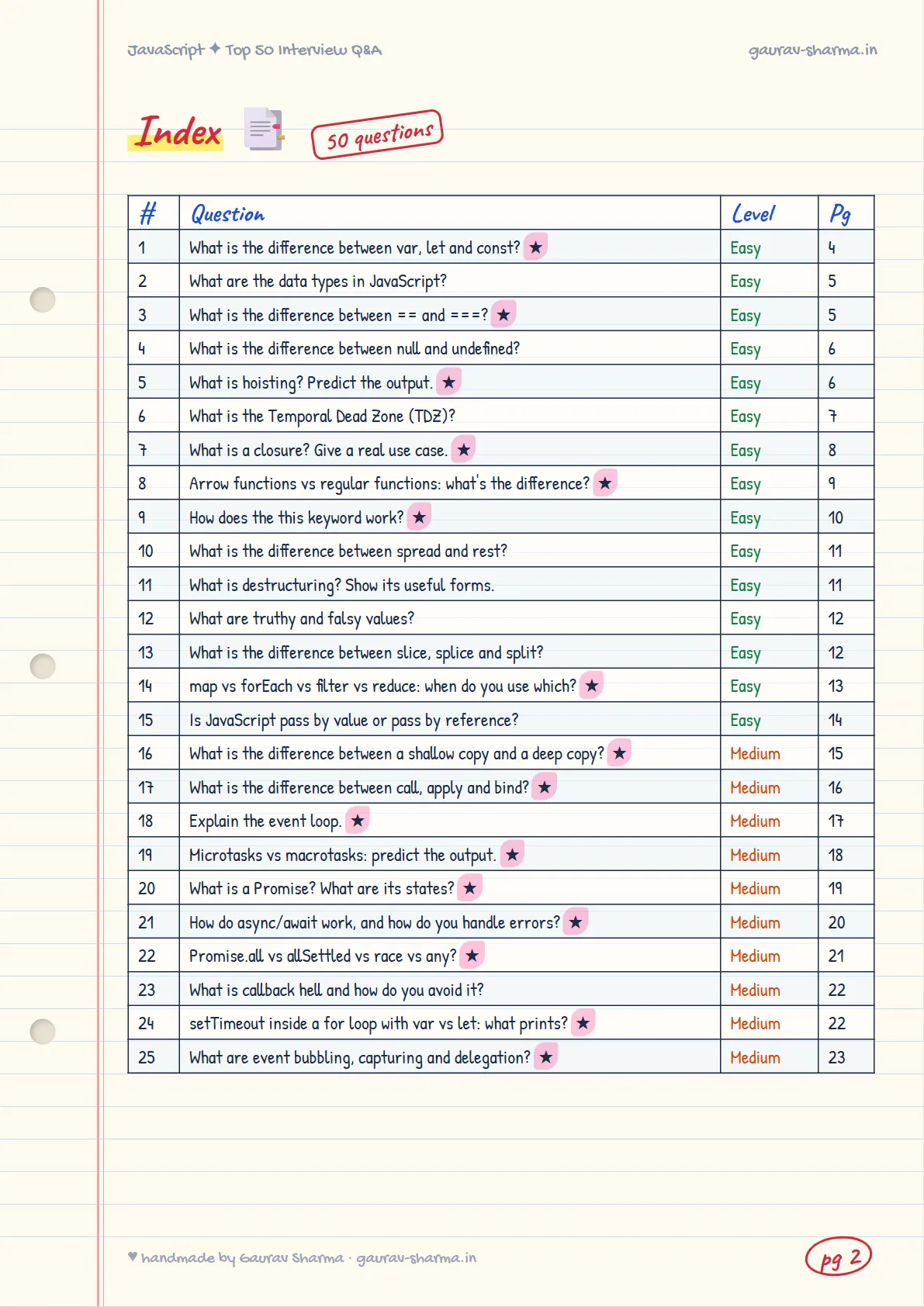
01What is the difference between var, let and const?
varis function-scoped, hoisted with the valueundefinedand can be redeclared.letandconstare block-scoped and stay in the Temporal Dead Zone until their line runs.constalso can't be reassigned.EasyMost asked
02What are the data types in JavaScript?
8 types: 7 primitives (string, number, bigint, boolean, undefined, null, symbol) and object. Arrays, functions and dates are all objects. Primitives are immutable and copied by value; objects are shared by reference.
Easy
03What is the difference between == and ===?
===(strict) compares value and type with no conversion.==(loose) first converts the types (coercion), then compares. Always use===; the one accepted exception isx == null, which checks null or undefined.EasyMost asked
04What is the difference between null and undefined?
undefinedmeans a value was never assigned (JavaScript sets it).nullis an intentional "no value" that the programmer sets.Easy
05What is hoisting? Predict the output.
Before running, JS registers every declaration: functions fully,
varasundefined,let/const/classuninitialised (TDZ).EasyMost asked
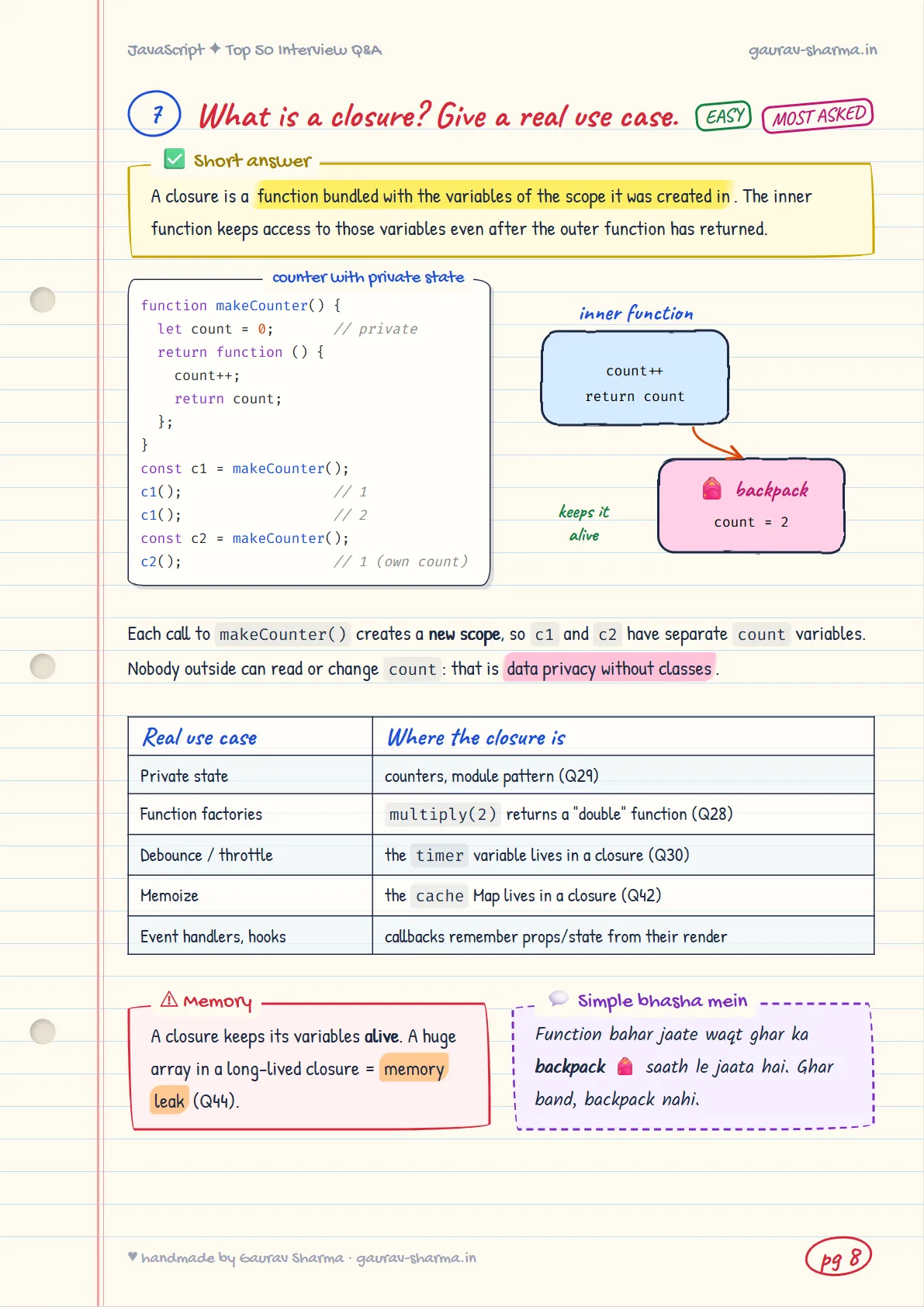
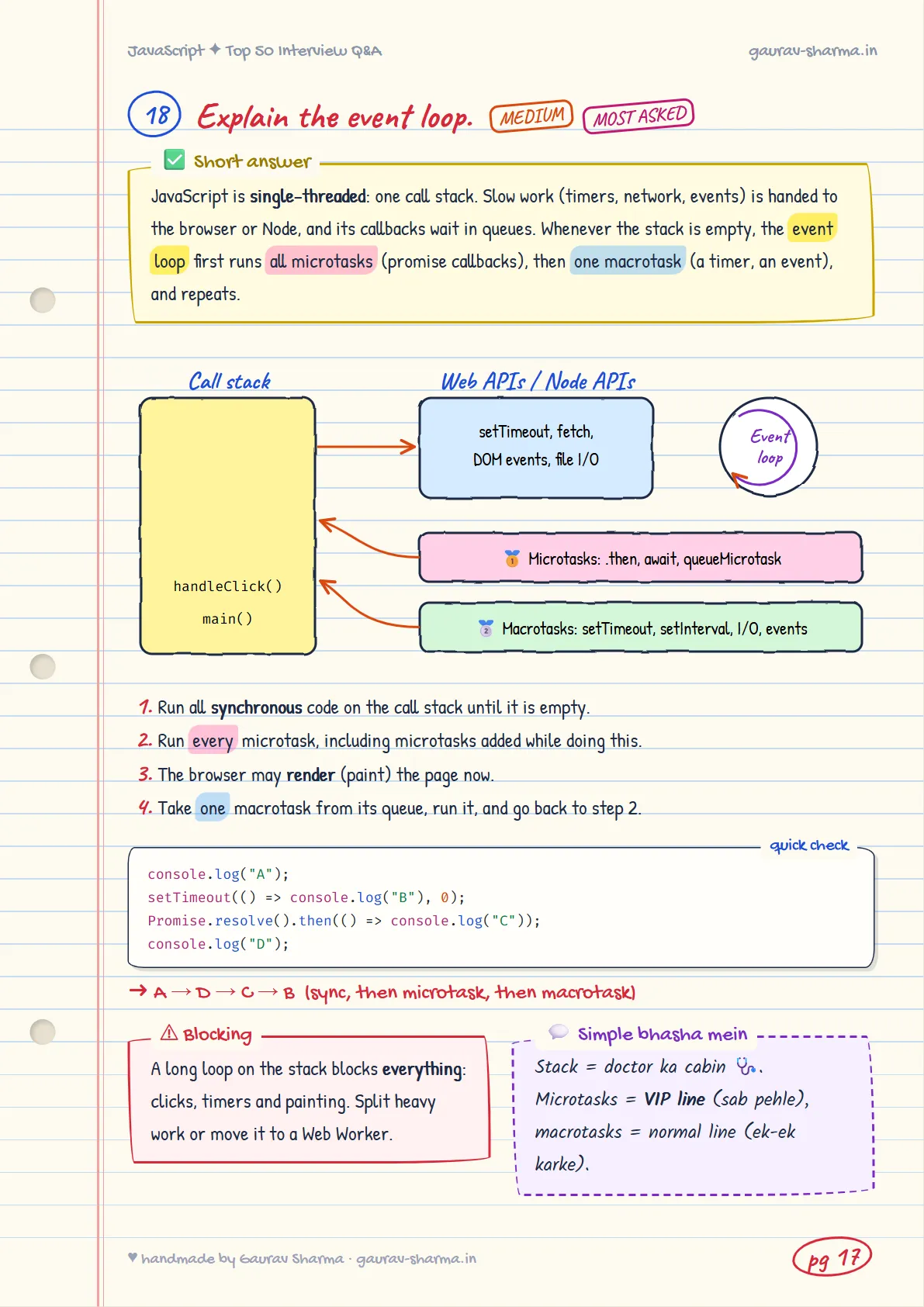
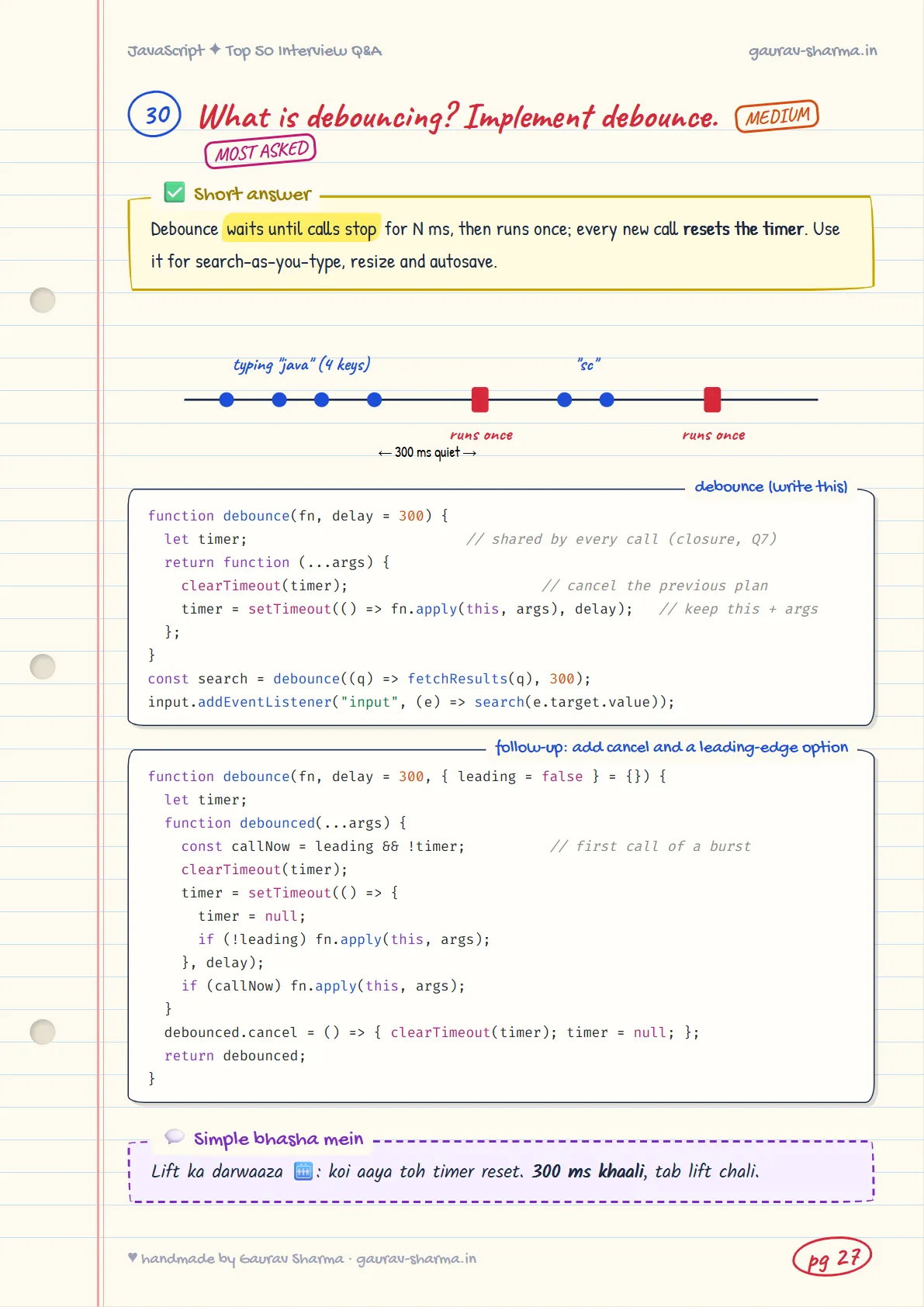
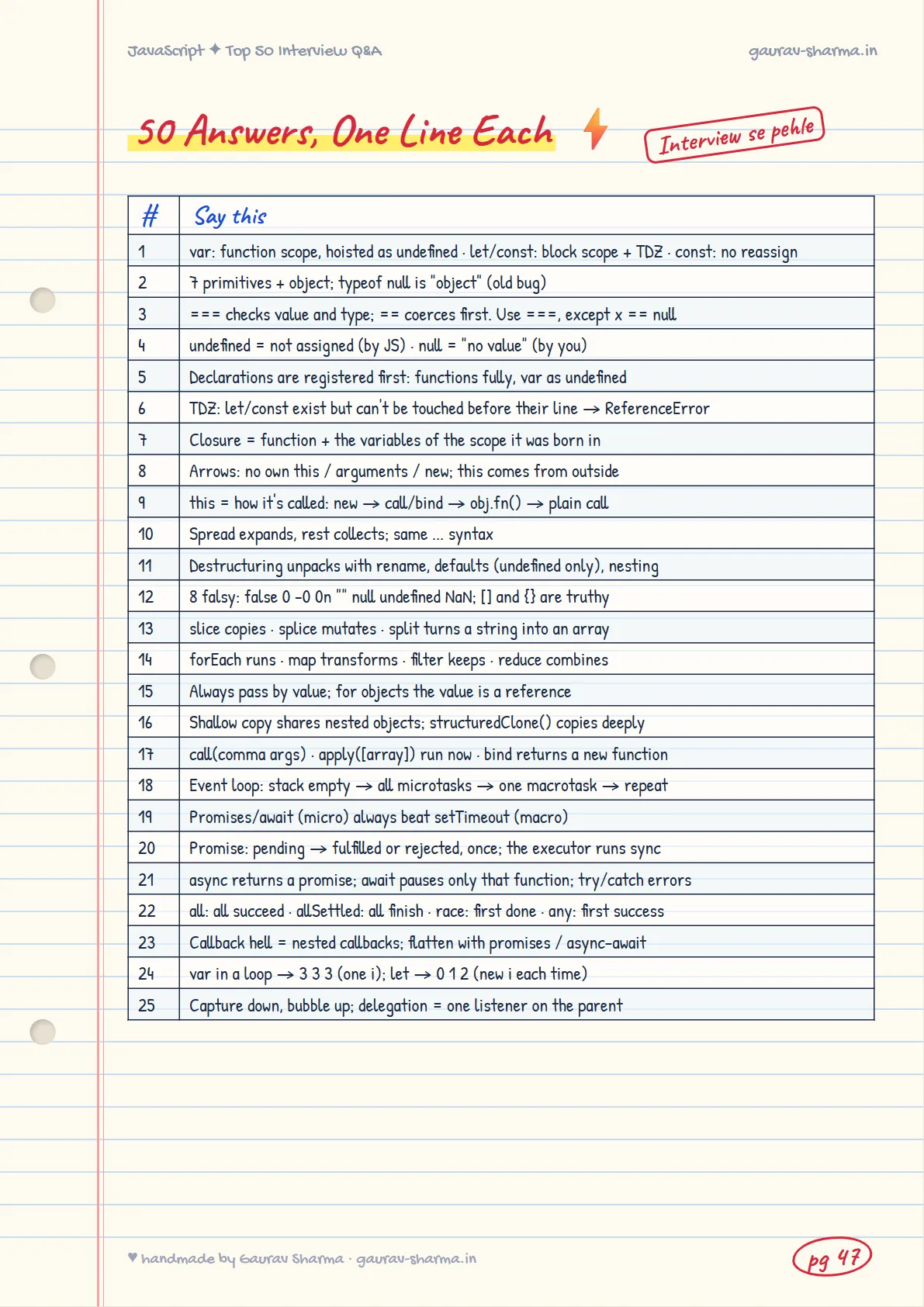
These are the 50 JavaScript questions that come up again and again in fresher and junior interviews, in the order of difficulty you're likely to face them. Every answer starts with a short version you can say in two lines, then explains the why with code, output and the traps interviewers look for.
What does each answer include?
- A short answer first. The one or two lines to say before going into detail, so you never ramble.
- A detailed explanation. Code you can paste into the console, the exact output, and tables or sketches for things like the event loop and the prototype chain.
- Traps and follow-ups. The mistakes people make and the next question the interviewer usually asks.
- Coding answers. Working implementations of debounce, throttle, deep clone, flatten, Promise.all, bind/call/apply, curry, memoize, an EventEmitter, retry with backoff and an LRU cache.
How should you prepare with these questions?
Start with the starred "most asked" questions in the index. Read each short answer out loud, run the snippets yourself, and write the 8 coding questions from memory at least once. The night before, revise from the two pages of one-line answers at the end.
This is Part 1 of the Interview Q&A series. To learn the concepts behind these answers, start with the free JavaScript handwritten notes.
FAQ
Questions about this PDF
Is this JavaScript interview questions PDF free?
Yes. The full 49-page PDF with all 50 questions and answers is free; email me to request the complete PDF.
Are these JavaScript questions good for freshers?
Yes. Questions 1 to 15 cover fresher basics like var/let/const, hoisting, closures and this. Questions 16 to 35 cover async JavaScript and the DOM, and 36 to 50 are the coding and polyfill questions asked for 0 to 2 years of experience.
Does the PDF include output-based questions?
Yes. It includes the common predict-the-output questions on hoisting, == coercion, closures in loops, this, microtasks vs macrotasks and async/await ordering, each with a step-by-step explanation.
How is this different from the JavaScript handwritten notes?
The handwritten notes (Placement Series, Part 1) teach the concepts one page at a time. This PDF is the interview layer on top: the exact questions, a short answer to say first, the detailed answer, traps and follow-up questions.
Placement Series
More from the series
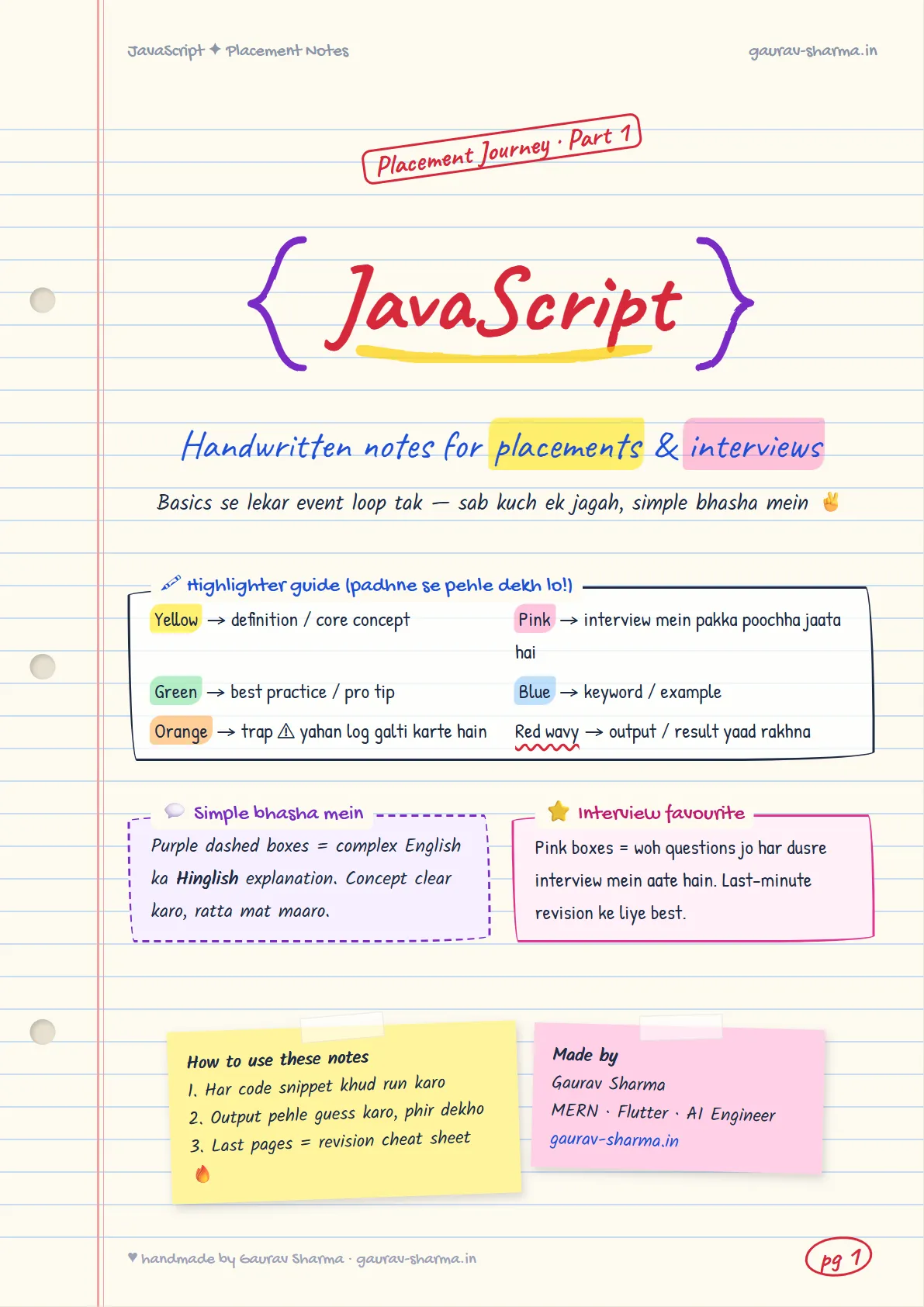
Handwritten notes · Part 1
JavaScript Handwritten Notes for Placements (Free PDF)
26 pages of handwritten-style JavaScript notes for placements and interviews: hoisting, closures, this, prototypes, promises, the event loop, polyfills and output-based questions, explained in English with Hinglish.
- 26 pages
- English + Hinglish
- Free by email
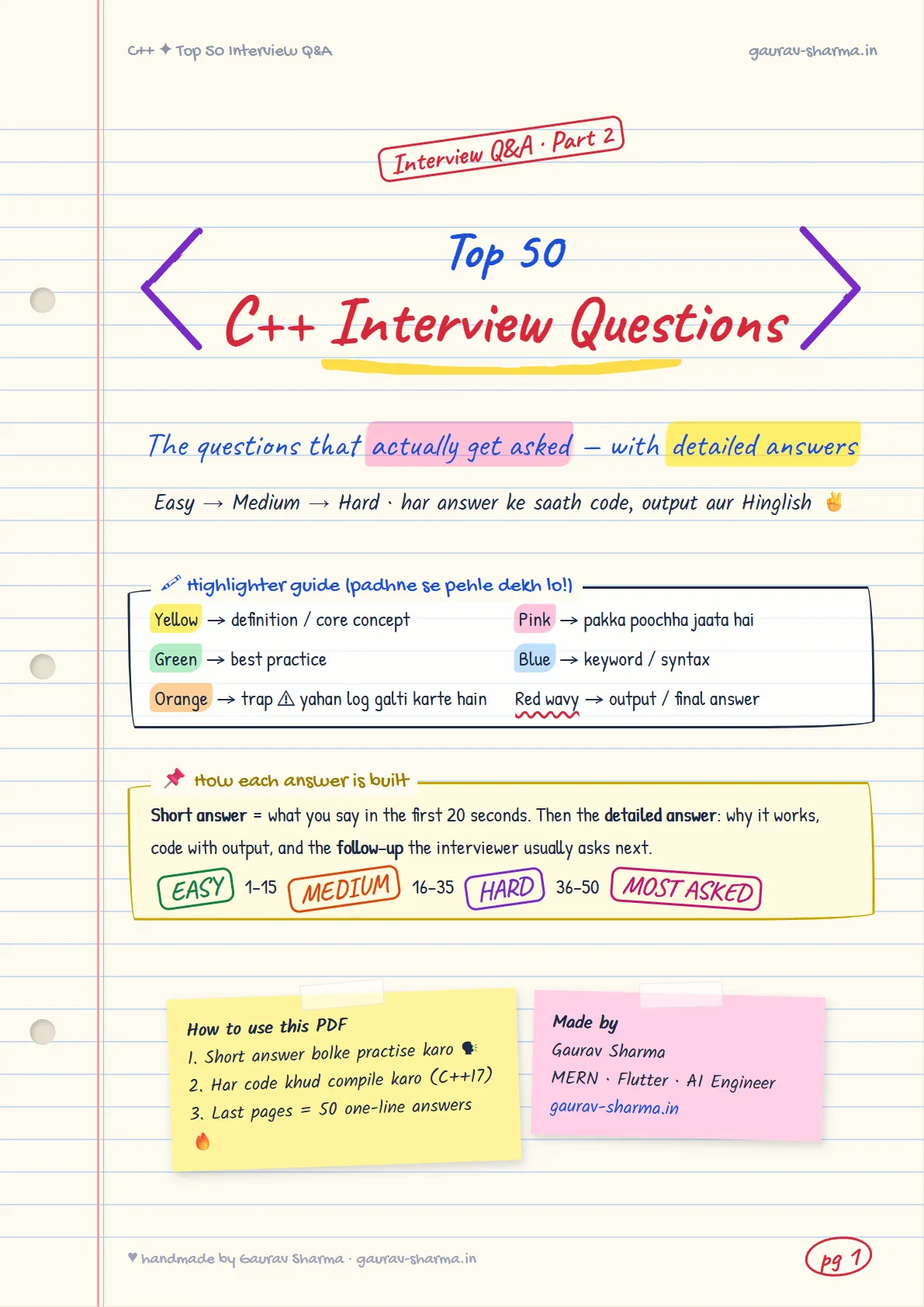
Interview questions · Part 2
Top 50 C++ Interview Questions with Answers (Free PDF)
56 pages covering the 50 most-asked C++ interview questions, each with a short answer to say first and a detailed answer with code, output and follow-ups: OOP, pointers vs references, virtual functions and vtable, virtual destructors, Rule of 3/5/0, smart pointers, RAII, STL, move semantics, output questions and coding questions, with Hinglish explanations.
- 56 pages
- English + Hinglish
- Free by email
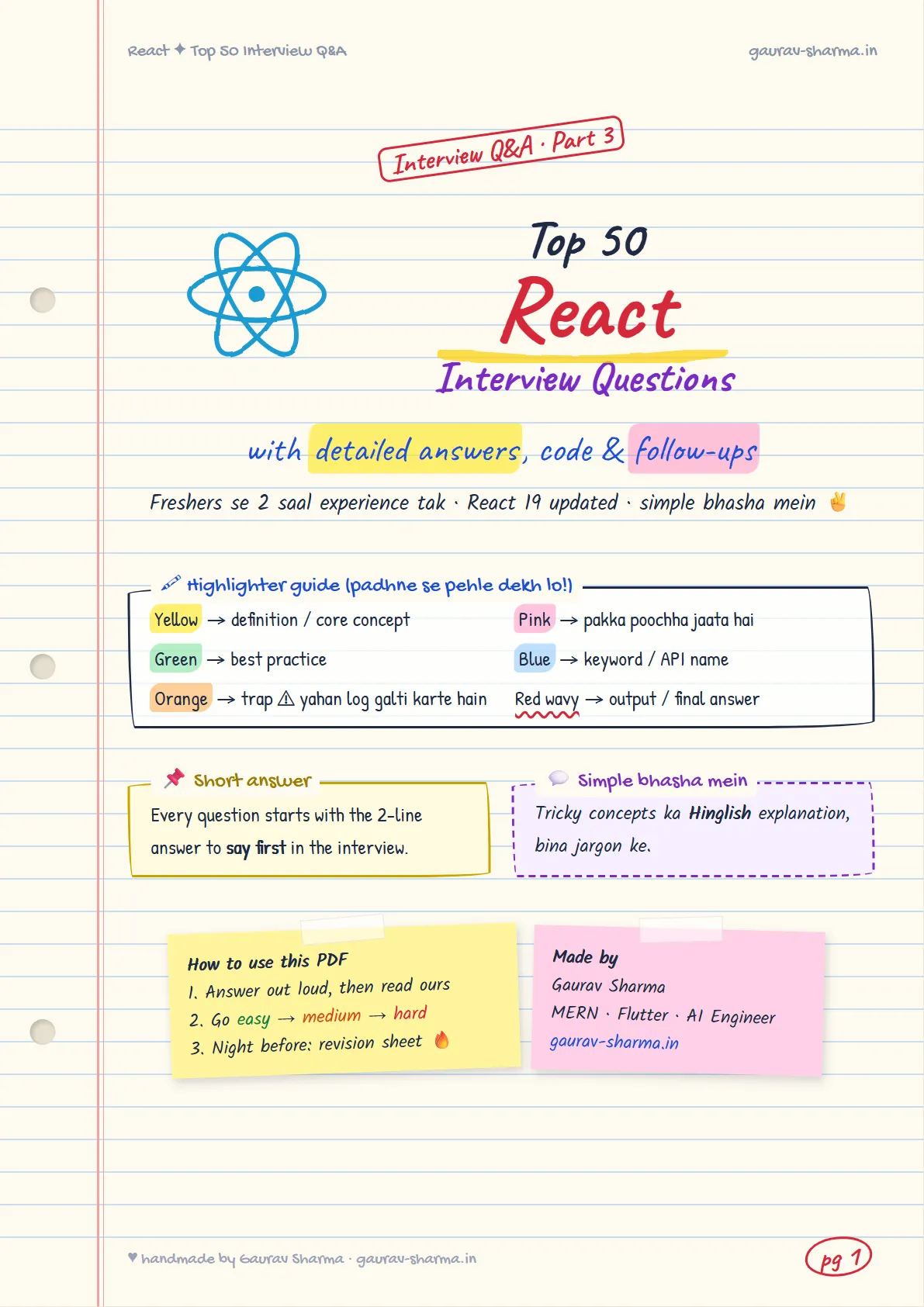
Interview questions · Part 3
Top 50 React Interview Questions with Answers (Free PDF)
The 50 most-asked React interview questions with detailed answers, for freshers and developers with up to 2 years of experience: virtual DOM, keys, props vs state, every common hook, re-renders, reconciliation, Fiber, concurrent rendering, React 19 Actions, Server Components, hydration, performance, testing and four coding questions, with code, diagrams and Hinglish explanations.
- 51 pages
- English + Hinglish
- Free by email
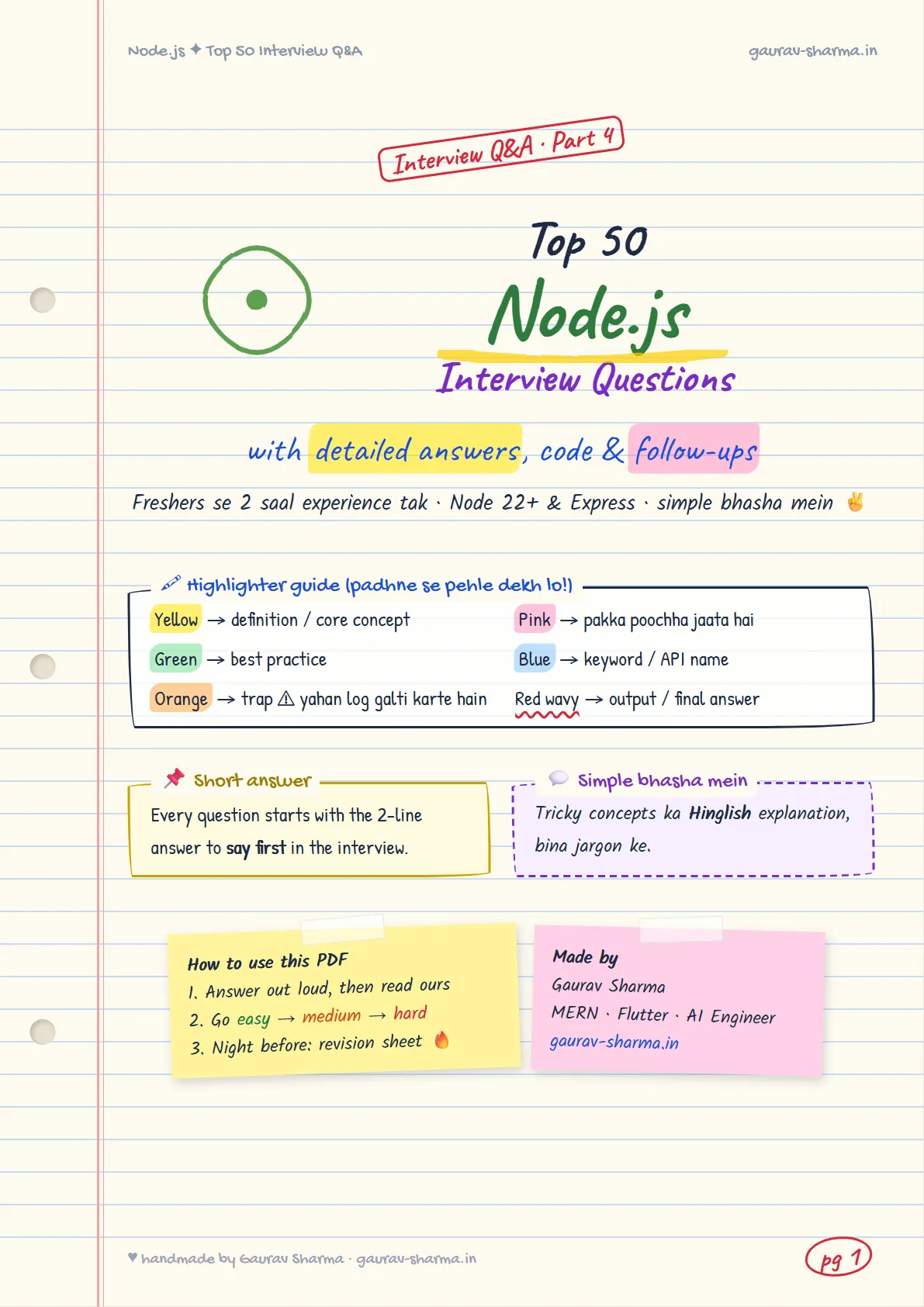
Interview questions · Part 4
Top 50 Node.js Interview Questions with Answers (Free PDF)
The 50 most-asked Node.js interview questions with detailed answers, for freshers and backend developers with up to 2 years of experience: the event loop, libuv, process.nextTick vs setImmediate, streams and backpressure, EventEmitter, cluster vs worker_threads vs child_process, Express middleware, JWT auth, Mongoose, graceful shutdown, testing, and coding and output-prediction questions, with code and Hinglish explanations.
- 61 pages
- English + Hinglish
- Free by email
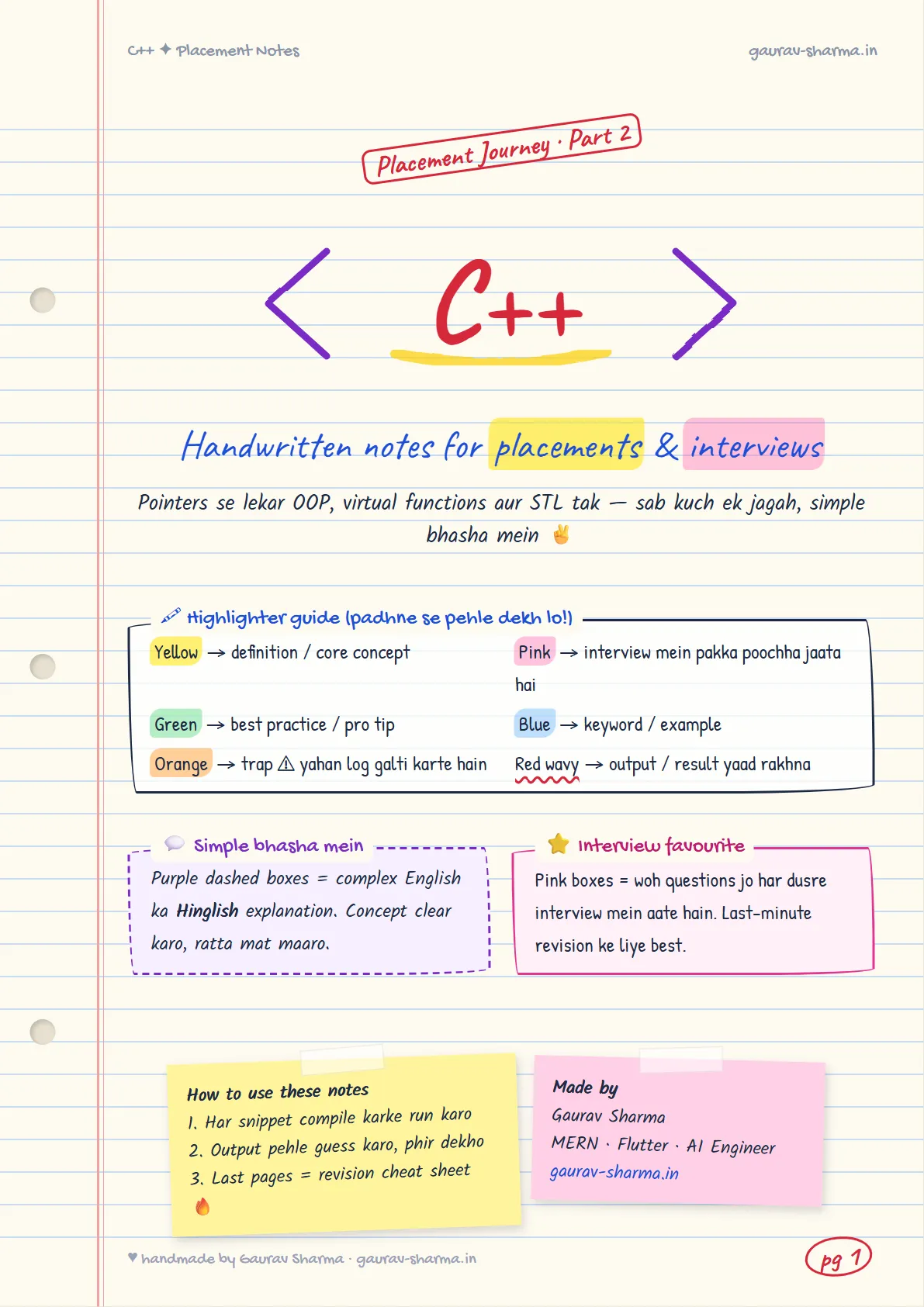
Handwritten notes · Part 2
C++ Handwritten Notes for Placements (Free PDF)
26 pages of handwritten-style C++ notes for placements and interviews: pointers, references, memory, OOP, virtual functions and vtables, templates, STL and smart pointers, explained in English with Hinglish.
- 26 pages
- English + Hinglish
- Free by email
Handwritten notes · Part 3
React Handwritten Notes for Placements (Free PDF)
26 pages of handwritten-style React notes for placements and frontend interviews: JSX, state, useEffect, useRef, memoization, Context, useReducer, custom hooks, virtual DOM, React Router, Redux Toolkit, React 18 and 19, and SSR, explained in English with Hinglish.
- 26 pages
- English + Hinglish
- Free by email
Handwritten notes · Part 4
Node.js Handwritten Notes for Placements (Free PDF)
26 pages of handwritten-style Node.js notes for placements and backend interviews: the event loop, libuv thread pool, modules, streams, Express middleware, REST APIs, JWT auth, security, MongoDB, scaling and Socket.io, explained in English with Hinglish.
- 26 pages
- English + Hinglish
- Free by email
Handwritten notes · Part 5
Python Handwritten Notes for Placements (Free PDF)
26 pages of handwritten-style Python notes for placements and interviews: mutability, lists and dicts, comprehensions, *args and **kwargs, decorators, generators, OOP, dunder methods, the GIL and Python for DSA, explained in English with Hinglish.
- 26 pages
- English + Hinglish
- Free by email
Handwritten notes · Part 6
SQL Handwritten Notes for Placements (Free PDF)
26 pages of handwritten-style SQL and DBMS notes for placements and interviews: joins, NULL traps, order of execution, GROUP BY, subqueries, CTEs, window functions, Nth highest salary, normalization, indexes, ACID and isolation levels, explained in English with Hinglish.
- 26 pages
- English + Hinglish
- Free by email
Handwritten notes · Part 7
Operating System Handwritten Notes for Placements (Free PDF)
26 pages of handwritten-style OS notes for placements and interviews: processes, threads, CPU scheduling with Gantt charts, mutex vs semaphore, deadlock and Banker's algorithm, paging, virtual memory, page replacement and disk scheduling, with solved numericals, in English with Hinglish.
- 26 pages
- English + Hinglish
- Free by email
Handwritten notes · Part 8
Computer Networks Handwritten Notes for Placements (Free PDF)
26 pages of handwritten-style Computer Networks notes for placements and interviews: OSI and TCP/IP models, subnetting, ARP, DHCP, NAT, routing, TCP vs UDP, the 3-way handshake, DNS, HTTP, HTTPS and TLS, and what happens when you type a URL, with solved numericals, in English with Hinglish.
- 26 pages
- English + Hinglish
- Free by email
Handwritten notes · Part 9
OOPs Handwritten Notes for Placements (Free PDF)
26 pages of handwritten-style OOPs notes for placements and interviews: the 4 pillars, abstract class vs interface, overloading vs overriding, dynamic dispatch, composition vs aggregation, SOLID, design patterns, equals and hashCode, with Java examples and Hinglish explanations.
- 26 pages
- English + Hinglish
- Free by email
Handwritten notes · Part 10
Java Handwritten Notes for Placements (Free PDF)
26 pages of handwritten-style core Java notes for placements and interviews: JVM memory, the Integer cache, Strings, pass by value, Collections, HashMap internals, generics, multithreading, Java 8 streams and garbage collection, explained in English with Hinglish.
- 26 pages
- English + Hinglish
- Free by email
Handwritten notes · Part 11
DSA Handwritten Notes for Placements (Free PDF)
26 pages of handwritten-style DSA notes for placements and coding interviews: Big-O, sliding window, two pointers, binary search, linked lists, trees, heaps, graphs, Dijkstra, union-find, greedy and dynamic programming, with clean C++ templates and Hinglish explanations.
- 26 pages
- English + Hinglish
- Free by email
Handwritten notes · Part 12
Aptitude Handwritten Notes with Tricks for Placements (Free PDF)
26 pages of handwritten-style aptitude notes for placement tests: speed maths, number system, percentages, profit and loss, interest, time and work, time speed distance, permutations, probability, series, coding-decoding, blood relations, directions, seating, syllogisms and clocks, with shortcuts, solved examples and Hinglish explanations.
- 26 pages
- English + Hinglish
- Free by email
Handwritten notes · Part 13
System Design Handwritten Notes for Placements (Free PDF)
26 pages of handwritten-style system design notes for placements and interviews: a step-by-step answer framework, estimation, load balancers, caching, CDN, SQL vs NoSQL, replication, sharding, consistent hashing, CAP, Kafka, API design, rate limiting, microservices and reliability, plus case studies and a low-level design, with Hinglish explanations.
- 26 pages
- English + Hinglish
- Free by email
Handwritten notes · Part 14
TypeScript Handwritten Notes for Placements (Free PDF)
26 pages of handwritten-style TypeScript notes for placements and interviews: basic types, any vs unknown vs never, type vs interface, narrowing, discriminated unions, generics, keyof, utility types, mapped and conditional types, classes, enums, tsconfig, React and Node with Zod, common errors and a type quiz, with Hinglish explanations.
- 26 pages
- English + Hinglish
- Free by email
Handwritten notes · Part 15
Next.js Handwritten Notes for Placements (Free PDF, Next.js 16)
26 pages of handwritten-style Next.js 16 notes for placements and interviews: App Router, special files, dynamic and parallel routes, Server vs Client Components, data fetching and streaming, use cache, cacheLife and revalidation, Partial Prerendering, Server Actions, forms, route handlers, proxy, metadata and SEO, with Hinglish explanations.
- 26 pages
- English + Hinglish
- Free by email
Handwritten notes · Part 16
C Language Handwritten Notes for Placements (Free PDF)
26 pages of handwritten-style C language notes for placements and interviews: compilation stages, data types and format specifiers, operators and precedence traps, functions and call by value, storage classes, arrays, strings, pointers, pointer arithmetic, const and function pointers, malloc and free, structure padding, bit manipulation, macros, file handling, undefined behaviour and an output quiz, with Hinglish explanations.
- 26 pages
- English + Hinglish
- Free by email
Handwritten notes · Part 17
Git and GitHub Handwritten Notes for Placements (Free PDF)
26 pages of handwritten-style Git and GitHub notes for placements and interviews: the three areas, commits and Git internals, branches, merge vs rebase, merge conflicts, fetch vs pull, forks and pull requests, branching strategies, reset vs revert, stash, cherry-pick, reflog, bisect, commit messages and GitHub Actions, with Hinglish explanations.
- 26 pages
- English + Hinglish
- Free by email
Handwritten notes · Part 18
HTML and CSS Handwritten Notes for Placements (Free PDF)
26 pages of handwritten-style HTML and CSS notes for placements and frontend interviews: how the browser renders, semantic HTML5, images, forms, accessibility, meta tags, specificity and the cascade, box model, units, position and z-index, Flexbox, Grid, centering, responsive design, pseudo-elements, animations, CSS variables and modern CSS, with Hinglish explanations.
- 26 pages
- English + Hinglish
- Free by email
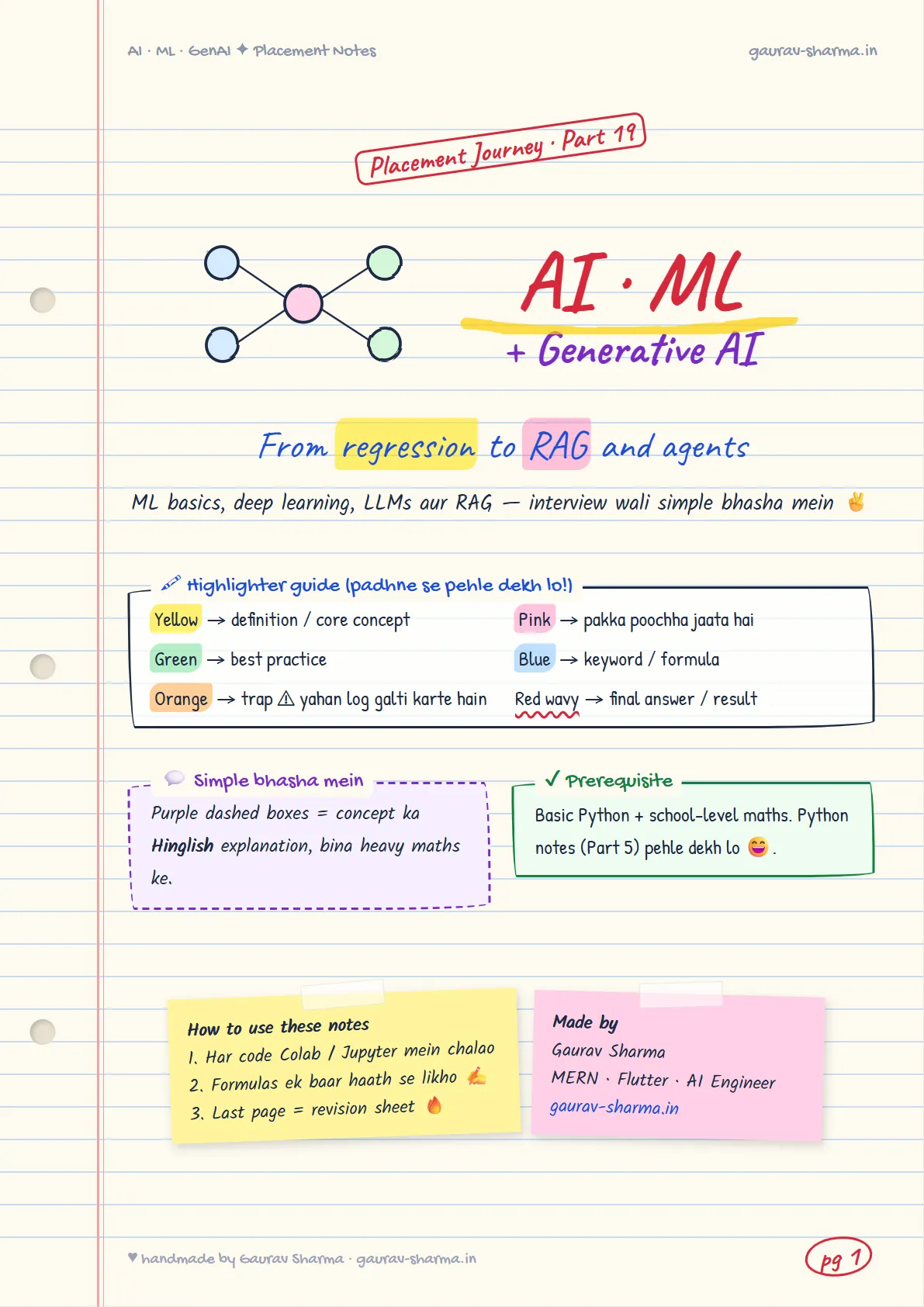
Handwritten notes · Part 19
AI, ML and Generative AI Handwritten Notes for Placements (Free PDF)
26 pages of handwritten-style AI, machine learning and generative AI notes for placements and interviews: ML types and workflow, regression, trees and ensembles, k-means and PCA, bias-variance, confusion matrix and F1, gradient descent, neural networks, CNN, RNN, transformers and attention, LLMs, prompt engineering, embeddings, RAG, agents and MCP, with Hinglish explanations.
- 26 pages
- English + Hinglish
- Free by email
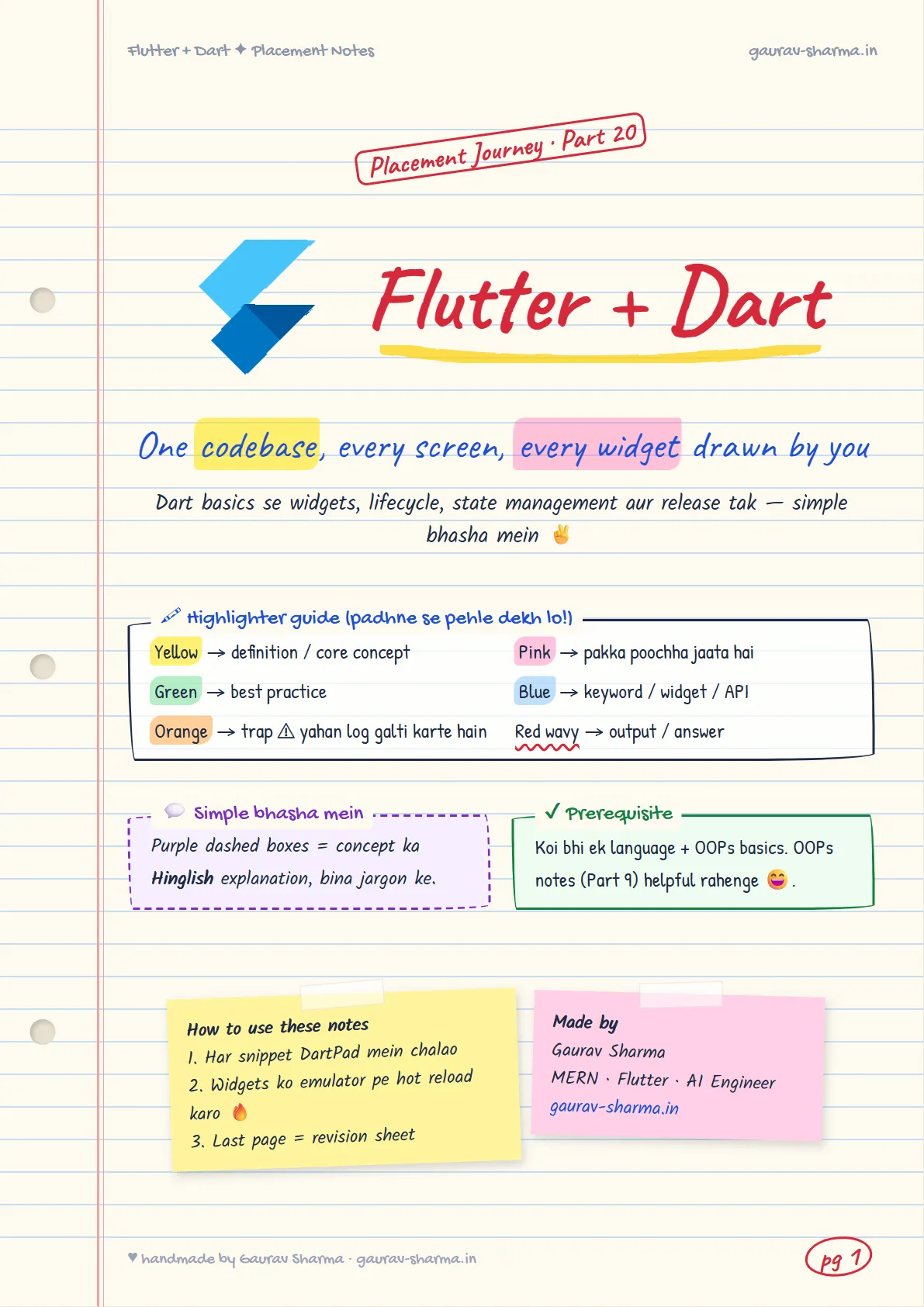
Handwritten notes · Part 20
Flutter and Dart Handwritten Notes for Placements (Free PDF)
26 pages of handwritten-style Flutter and Dart notes for placements and interviews: Dart basics, null safety, OOP, mixins, records and sealed classes, Futures, Streams and isolates, Stateless vs Stateful widgets, the State lifecycle, widget, element and render trees, keys, layout, navigation, forms, state management, networking, performance, testing and release, with Hinglish explanations.
- 26 pages
- English + Hinglish
- Free by email