
Handwritten notes · Part 11
DSA Handwritten Notes for Placements (Free PDF)
By Gaurav SharmaPublished
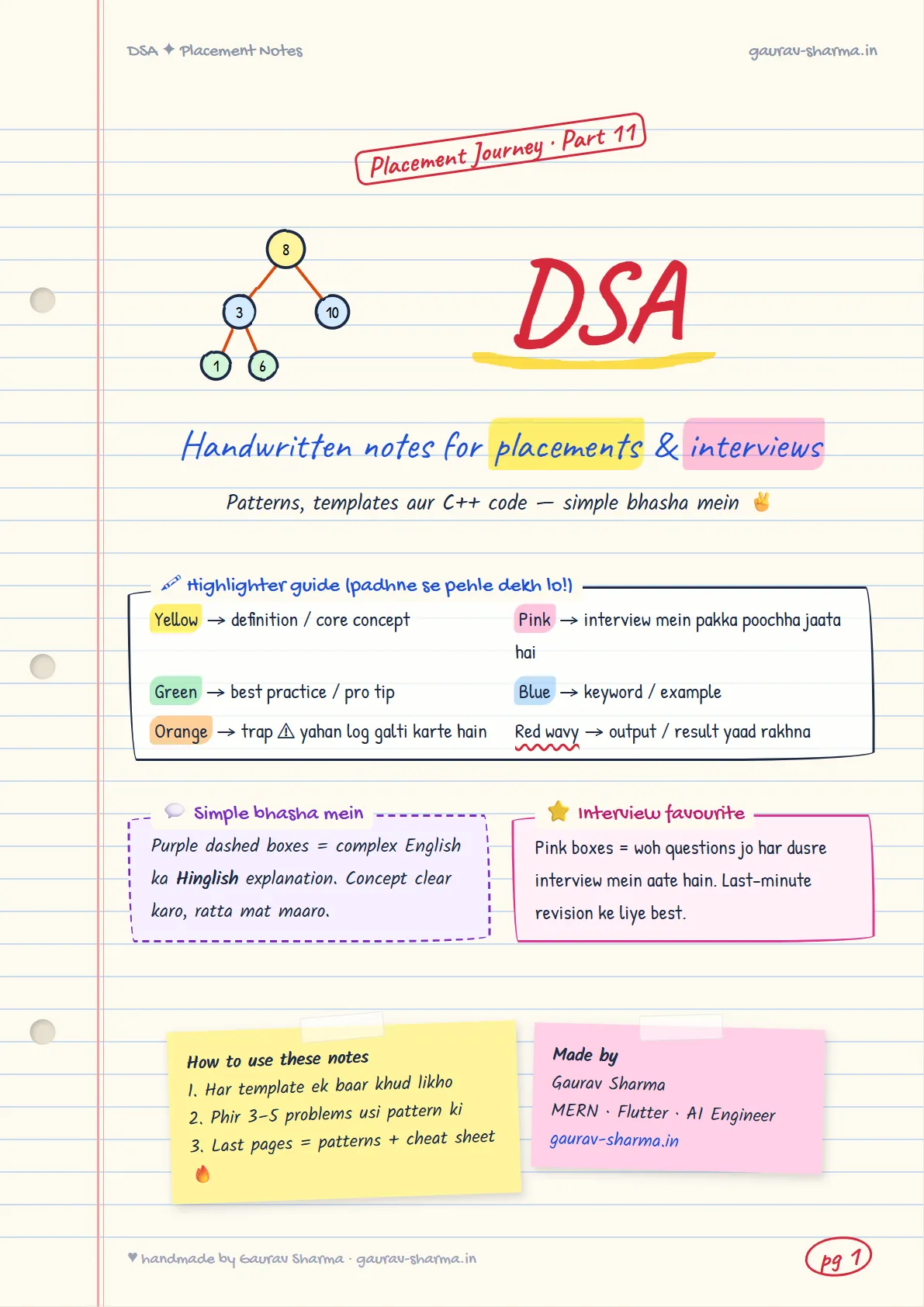
26 pages of handwritten-style DSA notes for placements and coding interviews: Big-O, sliding window, two pointers, binary search, linked lists, trees, heaps, graphs, Dijkstra, union-find, greedy and dynamic programming, with clean C++ templates and Hinglish explanations.
- Pages
- 26
- Format
- A4 PDF
- Language
- English + Hinglish
- Price
- Free by email
What's inside
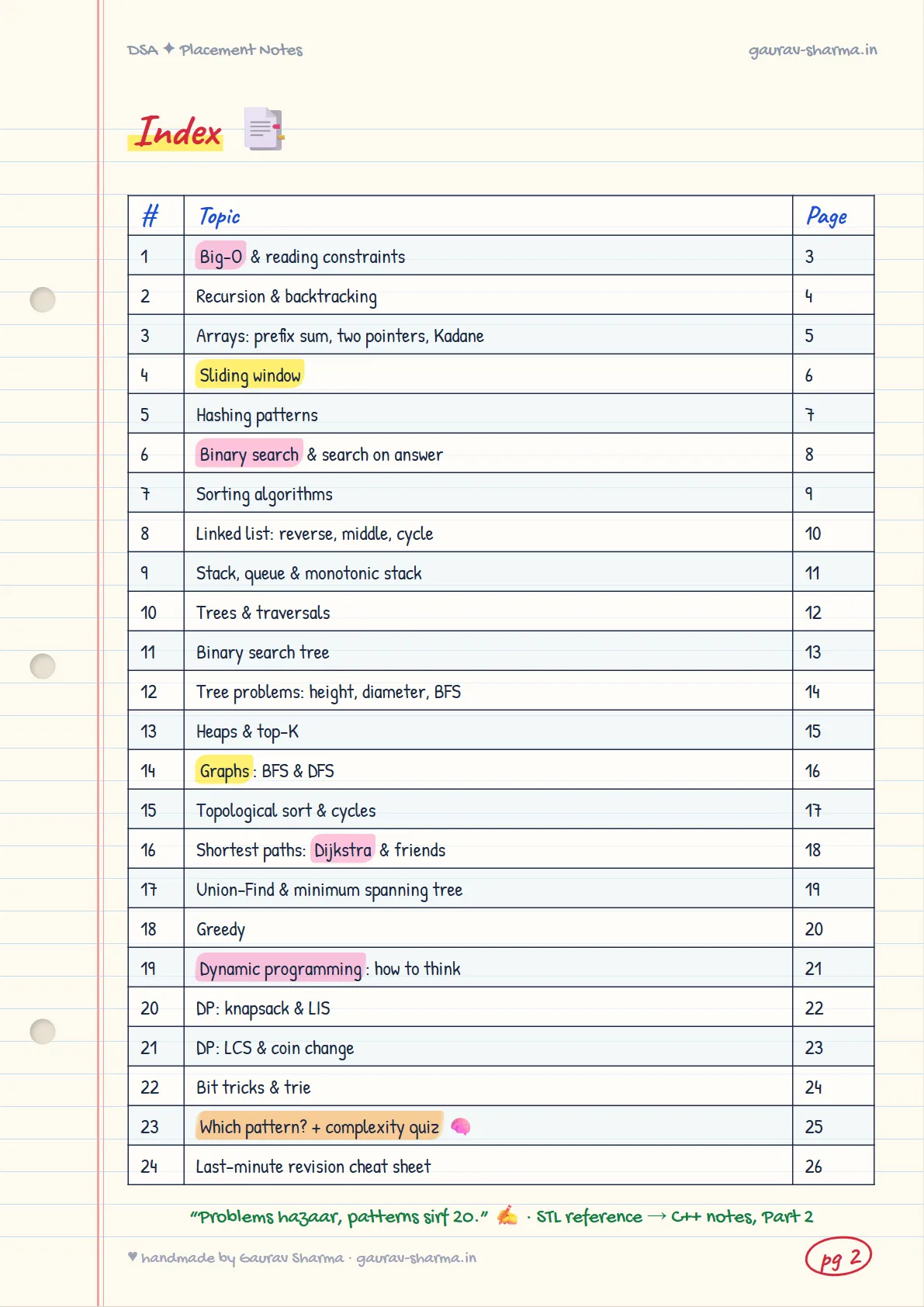
24 topics, one page each
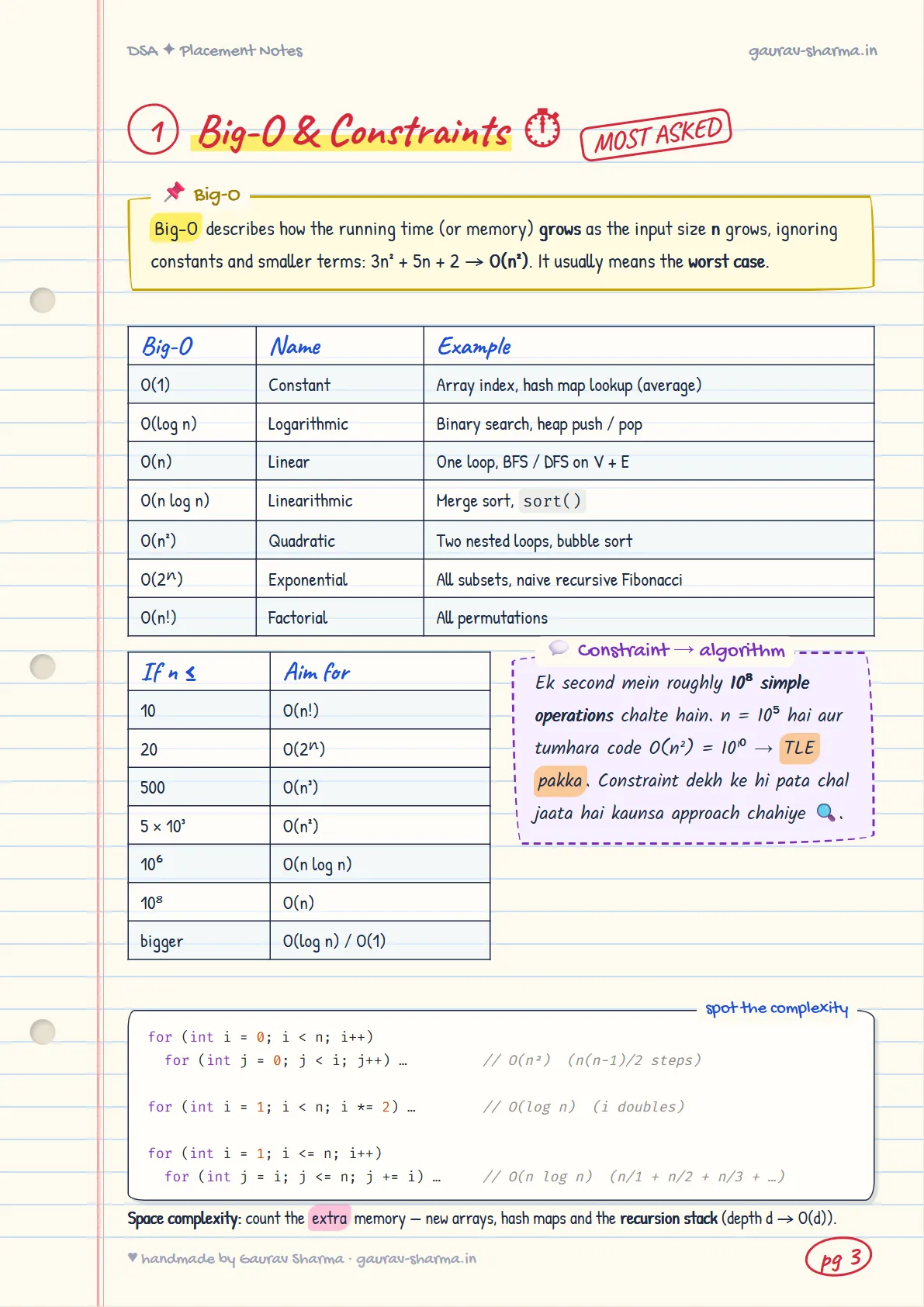
- 01Big-O, complexity classes and reading constraints
- 02Recursion and backtracking
- 03Prefix sums, two pointers and Kadane's algorithm
- 04Sliding window: fixed and variable
- 05Hashing patterns: two sum, subarray sum equals k
- 06Binary search, lower bound and search on the answer
- 07Sorting algorithms and their complexities
- 08Linked list: reverse, middle, Floyd's cycle detection
- 09Stack, queue and the monotonic stack
- 10Trees and the four traversals
- 11Binary search trees: search, insert, validate, LCA
- 12Tree problems: height, diameter, level order
- 13Heaps and top-K problems
- 14Graphs: representation, BFS and DFS
- 15Topological sort and cycle detection
- 16Shortest paths: Dijkstra, Bellman-Ford, Floyd-Warshall
- 17Union-find and minimum spanning trees
- 18Greedy algorithms and when they fail
- 19Dynamic programming: memoization vs tabulation
- 20DP: 0/1 knapsack and longest increasing subsequence
- 21DP: longest common subsequence and coin change
- 22Bit manipulation tricks and tries
- 23Which pattern to use, plus a complexity quiz
- 24Last-minute revision cheat sheet
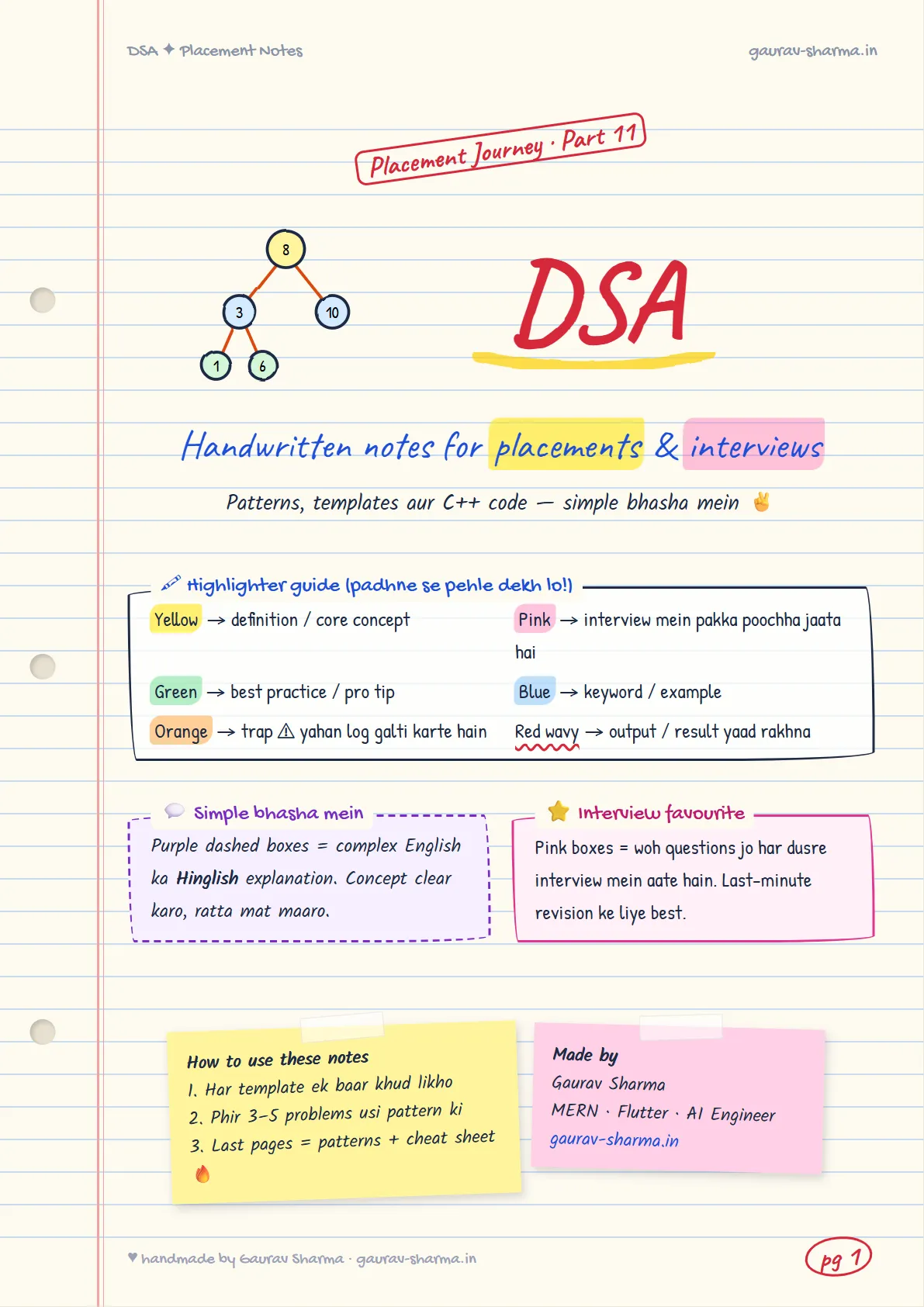
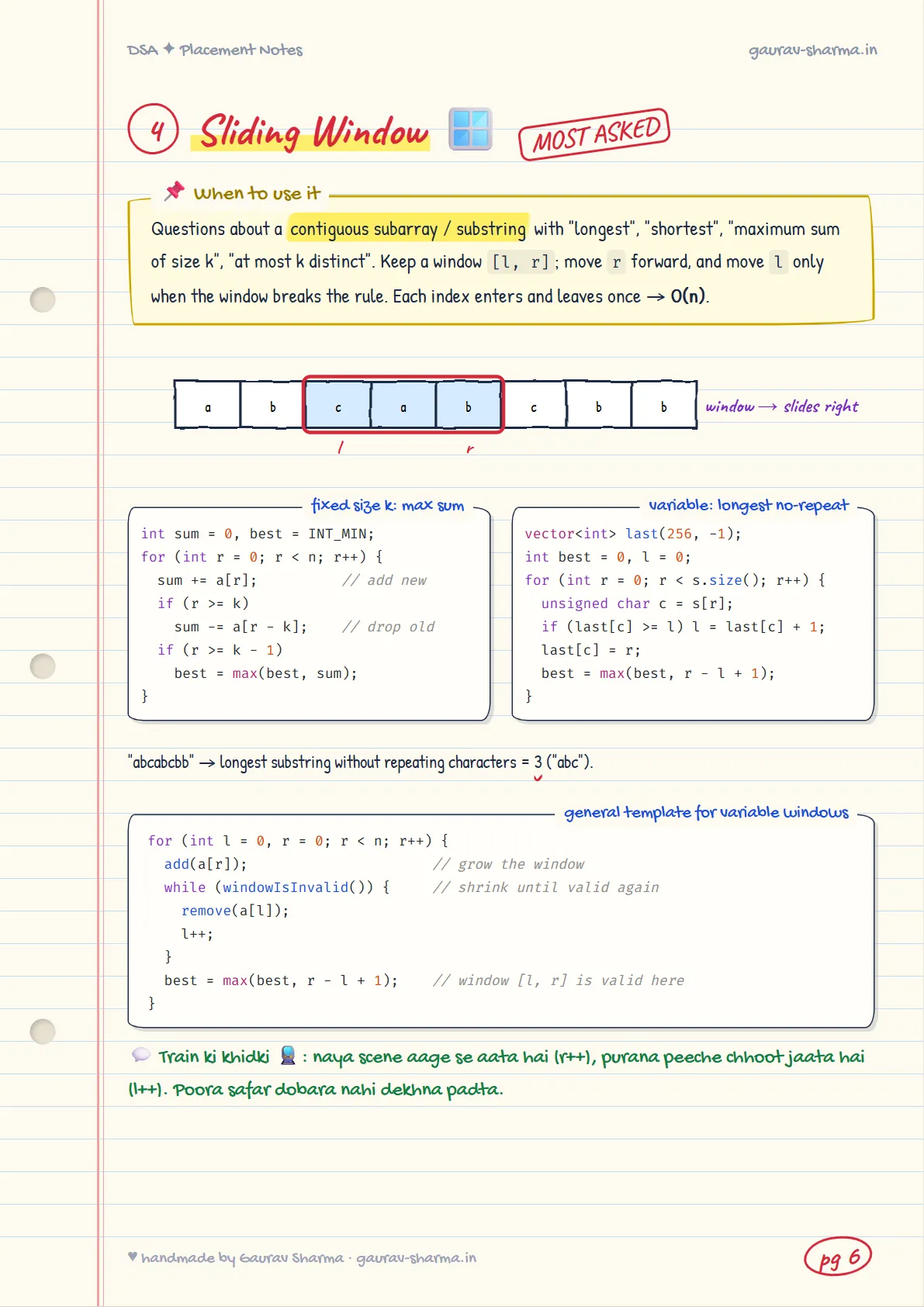
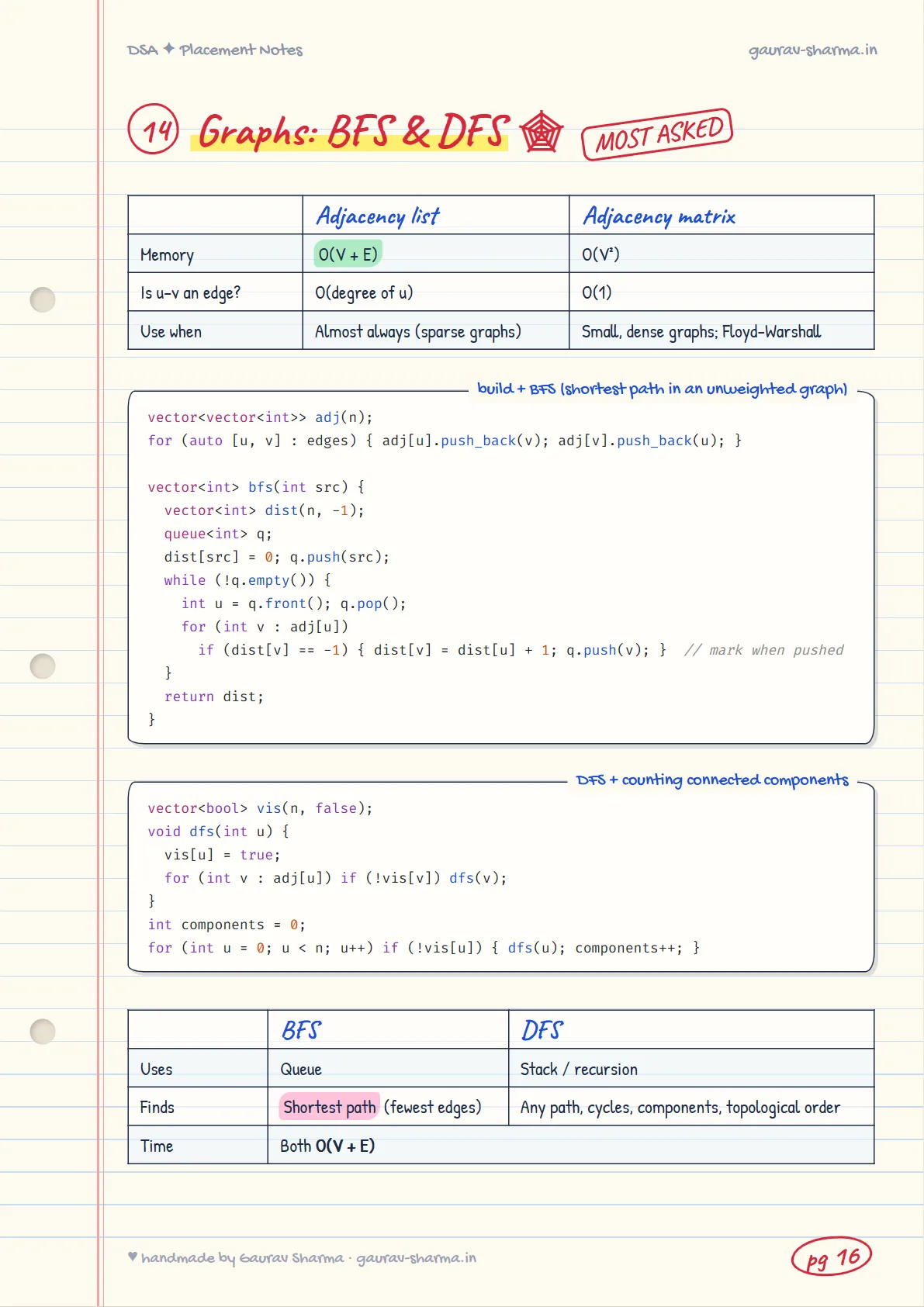
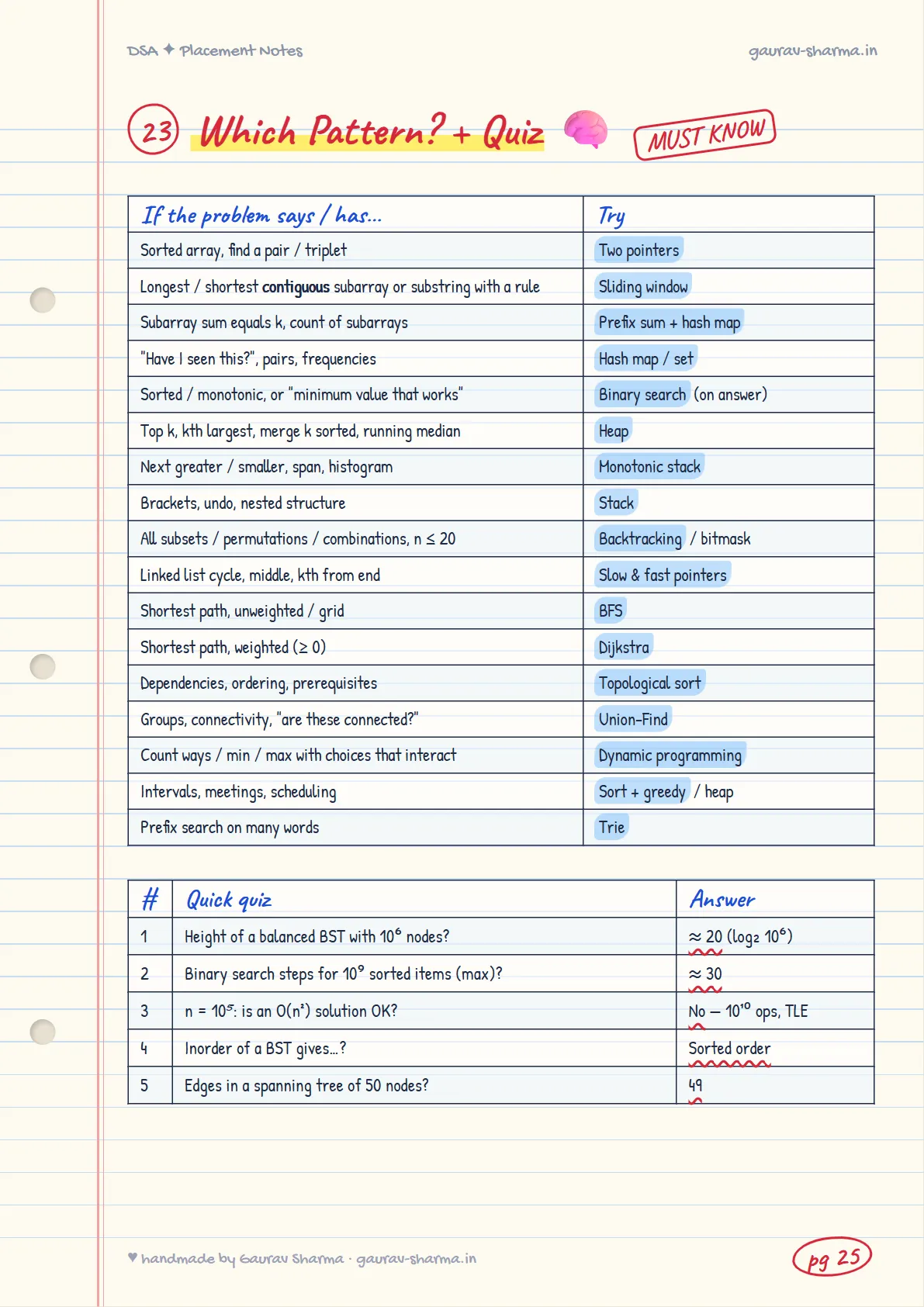
DSA rounds reward recognising patterns, not memorising thousands of problems. These notes give each important pattern one page: when to use it, a short C++ template you can write from memory, its complexity, and the classic problems it solves.
What makes these DSA notes different?
- Templates, not just theory. Sliding window, binary search on the answer, monotonic stack, BFS, Dijkstra, Kahn's topological sort, union-find and DP, each in a few clean lines of C++.
- "Which pattern?" table. A one-page map from what the problem says to what to try first.
- The traps that cause wrong answers. Mid-point overflow, validating a BST the wrong way, greedy failing on coin change, and the knapsack loop direction.
- Hinglish where it helps. Recursion, sliding window, heaps and DP each get a short Hinglish explanation.
How should you use these DSA notes?
Write each template once from memory, then solve three to five problems of that pattern. Use the complexity table to check your approach against the constraints before you code, and the last page as a revision sheet before the interview.
This is Part 11 of the series. For the C++ STL used in the code, see the C++ handwritten notes.
FAQ
Questions about these notes
Are these DSA notes really free?
Yes. The full 26-page PDF is free; email me to request the complete PDF. Share it with friends preparing for placements.
Which language is the code in?
C++, the most common choice for DSA rounds. The templates are short and use the STL; the C++ handwritten notes (Part 2) cover the STL itself. The logic carries over directly to Java or Python.
Do the notes teach how to recognise which pattern to use?
Yes. One page maps problem signals to patterns, for example 'longest substring with a rule' to sliding window or 'minimum value that works' to binary search on the answer, and every pattern page lists the classic problems it solves.
Is dynamic programming explained for beginners?
Yes. A 4-step recipe (state, transition, base cases, order), memoization vs tabulation, then worked 0/1 knapsack, LIS, LCS and coin change with the common loop-order traps.
Placement Series
More from the series
Handwritten notes · Part 1
JavaScript Handwritten Notes for Placements (Free PDF)
26 pages of handwritten-style JavaScript notes for placements and interviews: hoisting, closures, this, prototypes, promises, the event loop, polyfills and output-based questions, explained in English with Hinglish.
- 26 pages
- English + Hinglish
- Free by email
Handwritten notes · Part 2
C++ Handwritten Notes for Placements (Free PDF)
26 pages of handwritten-style C++ notes for placements and interviews: pointers, references, memory, OOP, virtual functions and vtables, templates, STL and smart pointers, explained in English with Hinglish.
- 26 pages
- English + Hinglish
- Free by email
Handwritten notes · Part 3
React Handwritten Notes for Placements (Free PDF)
26 pages of handwritten-style React notes for placements and frontend interviews: JSX, state, useEffect, useRef, memoization, Context, useReducer, custom hooks, virtual DOM, React Router, Redux Toolkit, React 18 and 19, and SSR, explained in English with Hinglish.
- 26 pages
- English + Hinglish
- Free by email
Handwritten notes · Part 4
Node.js Handwritten Notes for Placements (Free PDF)
26 pages of handwritten-style Node.js notes for placements and backend interviews: the event loop, libuv thread pool, modules, streams, Express middleware, REST APIs, JWT auth, security, MongoDB, scaling and Socket.io, explained in English with Hinglish.
- 26 pages
- English + Hinglish
- Free by email
Handwritten notes · Part 5
Python Handwritten Notes for Placements (Free PDF)
26 pages of handwritten-style Python notes for placements and interviews: mutability, lists and dicts, comprehensions, *args and **kwargs, decorators, generators, OOP, dunder methods, the GIL and Python for DSA, explained in English with Hinglish.
- 26 pages
- English + Hinglish
- Free by email
Handwritten notes · Part 6
SQL Handwritten Notes for Placements (Free PDF)
26 pages of handwritten-style SQL and DBMS notes for placements and interviews: joins, NULL traps, order of execution, GROUP BY, subqueries, CTEs, window functions, Nth highest salary, normalization, indexes, ACID and isolation levels, explained in English with Hinglish.
- 26 pages
- English + Hinglish
- Free by email
Handwritten notes · Part 7
Operating System Handwritten Notes for Placements (Free PDF)
26 pages of handwritten-style OS notes for placements and interviews: processes, threads, CPU scheduling with Gantt charts, mutex vs semaphore, deadlock and Banker's algorithm, paging, virtual memory, page replacement and disk scheduling, with solved numericals, in English with Hinglish.
- 26 pages
- English + Hinglish
- Free by email
Handwritten notes · Part 8
Computer Networks Handwritten Notes for Placements (Free PDF)
26 pages of handwritten-style Computer Networks notes for placements and interviews: OSI and TCP/IP models, subnetting, ARP, DHCP, NAT, routing, TCP vs UDP, the 3-way handshake, DNS, HTTP, HTTPS and TLS, and what happens when you type a URL, with solved numericals, in English with Hinglish.
- 26 pages
- English + Hinglish
- Free by email
Handwritten notes · Part 9
OOPs Handwritten Notes for Placements (Free PDF)
26 pages of handwritten-style OOPs notes for placements and interviews: the 4 pillars, abstract class vs interface, overloading vs overriding, dynamic dispatch, composition vs aggregation, SOLID, design patterns, equals and hashCode, with Java examples and Hinglish explanations.
- 26 pages
- English + Hinglish
- Free by email
Handwritten notes · Part 10
Java Handwritten Notes for Placements (Free PDF)
26 pages of handwritten-style core Java notes for placements and interviews: JVM memory, the Integer cache, Strings, pass by value, Collections, HashMap internals, generics, multithreading, Java 8 streams and garbage collection, explained in English with Hinglish.
- 26 pages
- English + Hinglish
- Free by email
Handwritten notes · Part 12
Aptitude Handwritten Notes with Tricks for Placements (Free PDF)
26 pages of handwritten-style aptitude notes for placement tests: speed maths, number system, percentages, profit and loss, interest, time and work, time speed distance, permutations, probability, series, coding-decoding, blood relations, directions, seating, syllogisms and clocks, with shortcuts, solved examples and Hinglish explanations.
- 26 pages
- English + Hinglish
- Free by email
Handwritten notes · Part 13
System Design Handwritten Notes for Placements (Free PDF)
26 pages of handwritten-style system design notes for placements and interviews: a step-by-step answer framework, estimation, load balancers, caching, CDN, SQL vs NoSQL, replication, sharding, consistent hashing, CAP, Kafka, API design, rate limiting, microservices and reliability, plus case studies and a low-level design, with Hinglish explanations.
- 26 pages
- English + Hinglish
- Free by email
Handwritten notes · Part 14
TypeScript Handwritten Notes for Placements (Free PDF)
26 pages of handwritten-style TypeScript notes for placements and interviews: basic types, any vs unknown vs never, type vs interface, narrowing, discriminated unions, generics, keyof, utility types, mapped and conditional types, classes, enums, tsconfig, React and Node with Zod, common errors and a type quiz, with Hinglish explanations.
- 26 pages
- English + Hinglish
- Free by email
Handwritten notes · Part 15
Next.js Handwritten Notes for Placements (Free PDF, Next.js 16)
26 pages of handwritten-style Next.js 16 notes for placements and interviews: App Router, special files, dynamic and parallel routes, Server vs Client Components, data fetching and streaming, use cache, cacheLife and revalidation, Partial Prerendering, Server Actions, forms, route handlers, proxy, metadata and SEO, with Hinglish explanations.
- 26 pages
- English + Hinglish
- Free by email
Handwritten notes · Part 16
C Language Handwritten Notes for Placements (Free PDF)
26 pages of handwritten-style C language notes for placements and interviews: compilation stages, data types and format specifiers, operators and precedence traps, functions and call by value, storage classes, arrays, strings, pointers, pointer arithmetic, const and function pointers, malloc and free, structure padding, bit manipulation, macros, file handling, undefined behaviour and an output quiz, with Hinglish explanations.
- 26 pages
- English + Hinglish
- Free by email
Handwritten notes · Part 17
Git and GitHub Handwritten Notes for Placements (Free PDF)
26 pages of handwritten-style Git and GitHub notes for placements and interviews: the three areas, commits and Git internals, branches, merge vs rebase, merge conflicts, fetch vs pull, forks and pull requests, branching strategies, reset vs revert, stash, cherry-pick, reflog, bisect, commit messages and GitHub Actions, with Hinglish explanations.
- 26 pages
- English + Hinglish
- Free by email
Handwritten notes · Part 18
HTML and CSS Handwritten Notes for Placements (Free PDF)
26 pages of handwritten-style HTML and CSS notes for placements and frontend interviews: how the browser renders, semantic HTML5, images, forms, accessibility, meta tags, specificity and the cascade, box model, units, position and z-index, Flexbox, Grid, centering, responsive design, pseudo-elements, animations, CSS variables and modern CSS, with Hinglish explanations.
- 26 pages
- English + Hinglish
- Free by email
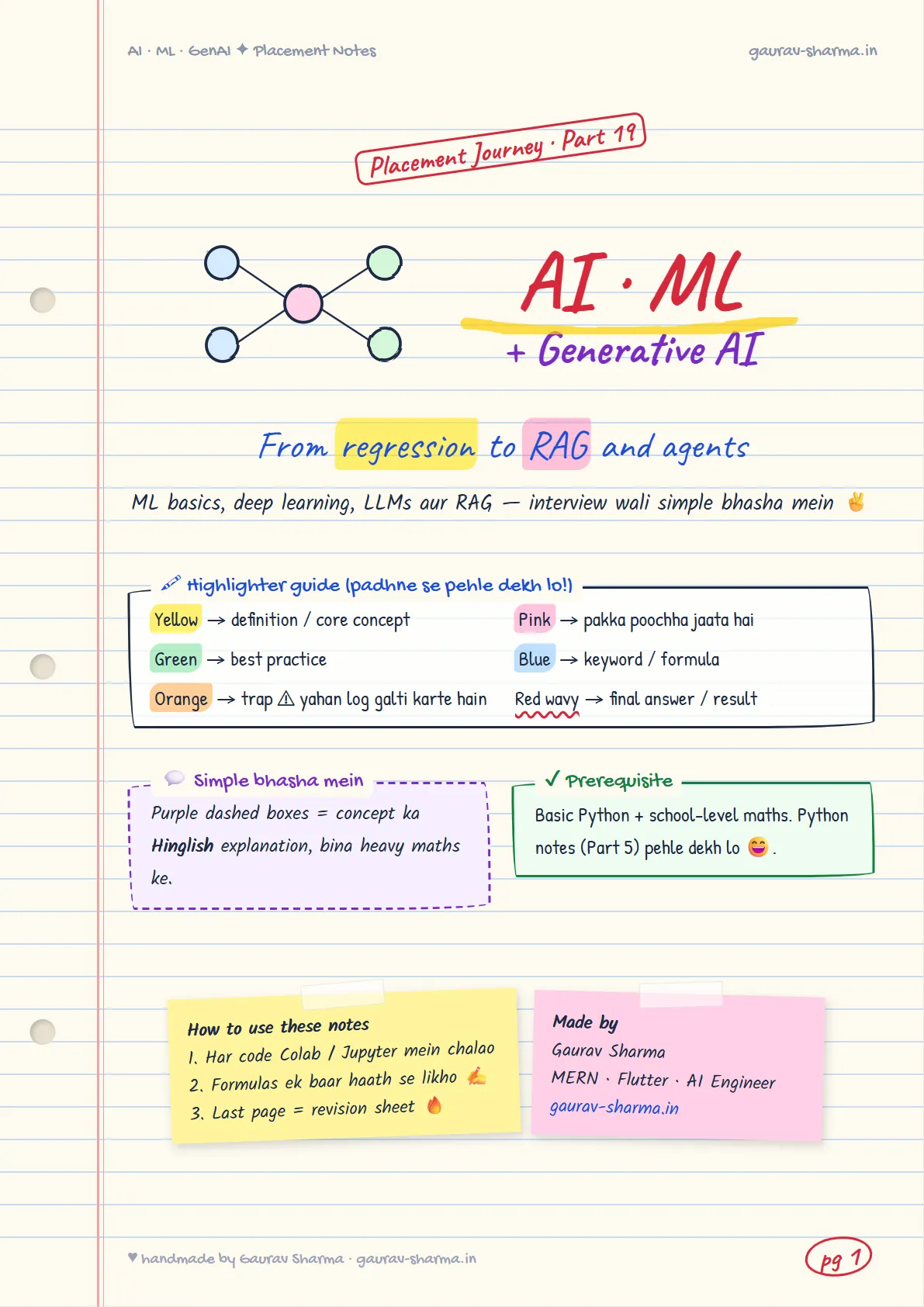
Handwritten notes · Part 19
AI, ML and Generative AI Handwritten Notes for Placements (Free PDF)
26 pages of handwritten-style AI, machine learning and generative AI notes for placements and interviews: ML types and workflow, regression, trees and ensembles, k-means and PCA, bias-variance, confusion matrix and F1, gradient descent, neural networks, CNN, RNN, transformers and attention, LLMs, prompt engineering, embeddings, RAG, agents and MCP, with Hinglish explanations.
- 26 pages
- English + Hinglish
- Free by email
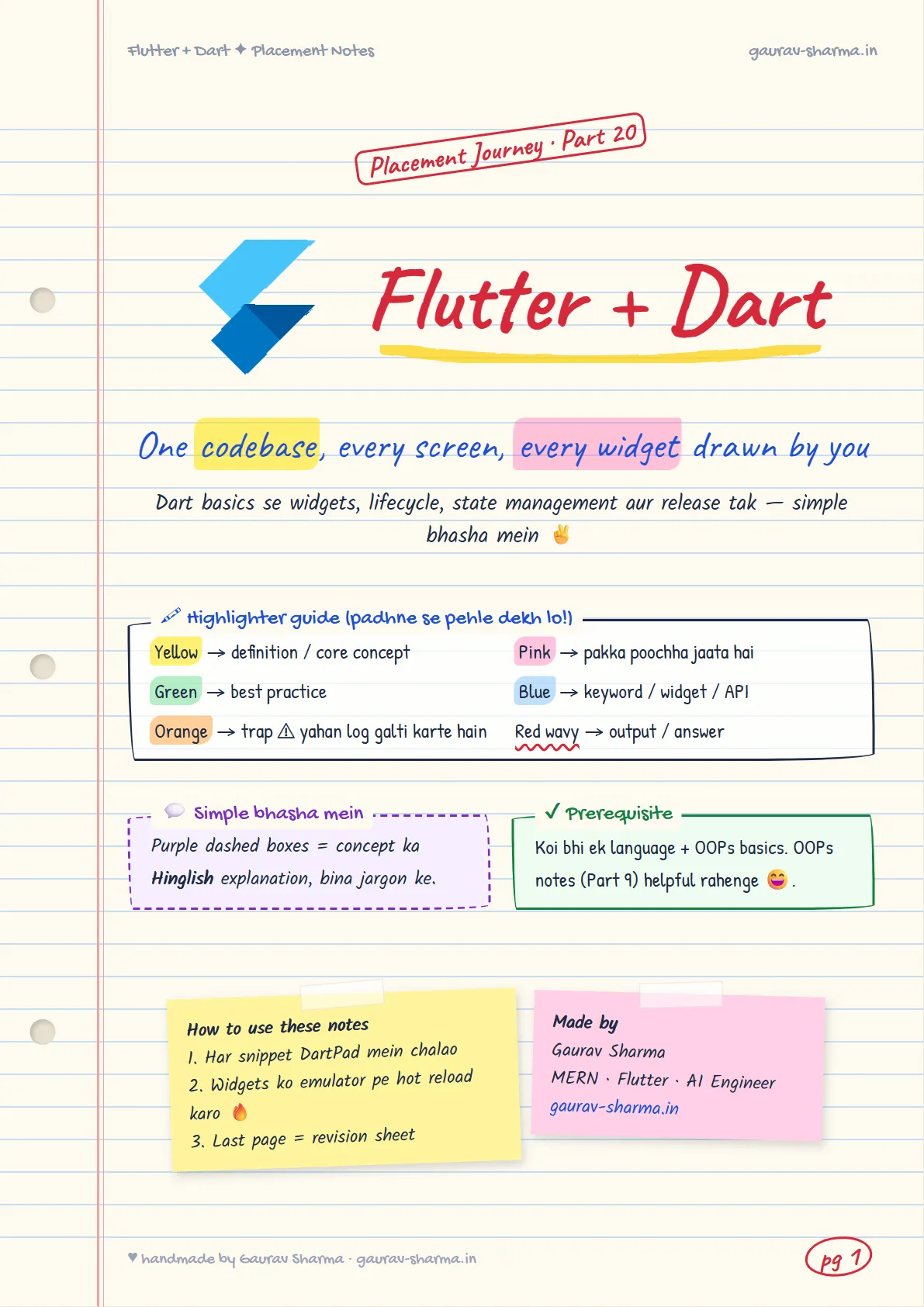
Handwritten notes · Part 20
Flutter and Dart Handwritten Notes for Placements (Free PDF)
26 pages of handwritten-style Flutter and Dart notes for placements and interviews: Dart basics, null safety, OOP, mixins, records and sealed classes, Futures, Streams and isolates, Stateless vs Stateful widgets, the State lifecycle, widget, element and render trees, keys, layout, navigation, forms, state management, networking, performance, testing and release, with Hinglish explanations.
- 26 pages
- English + Hinglish
- Free by email
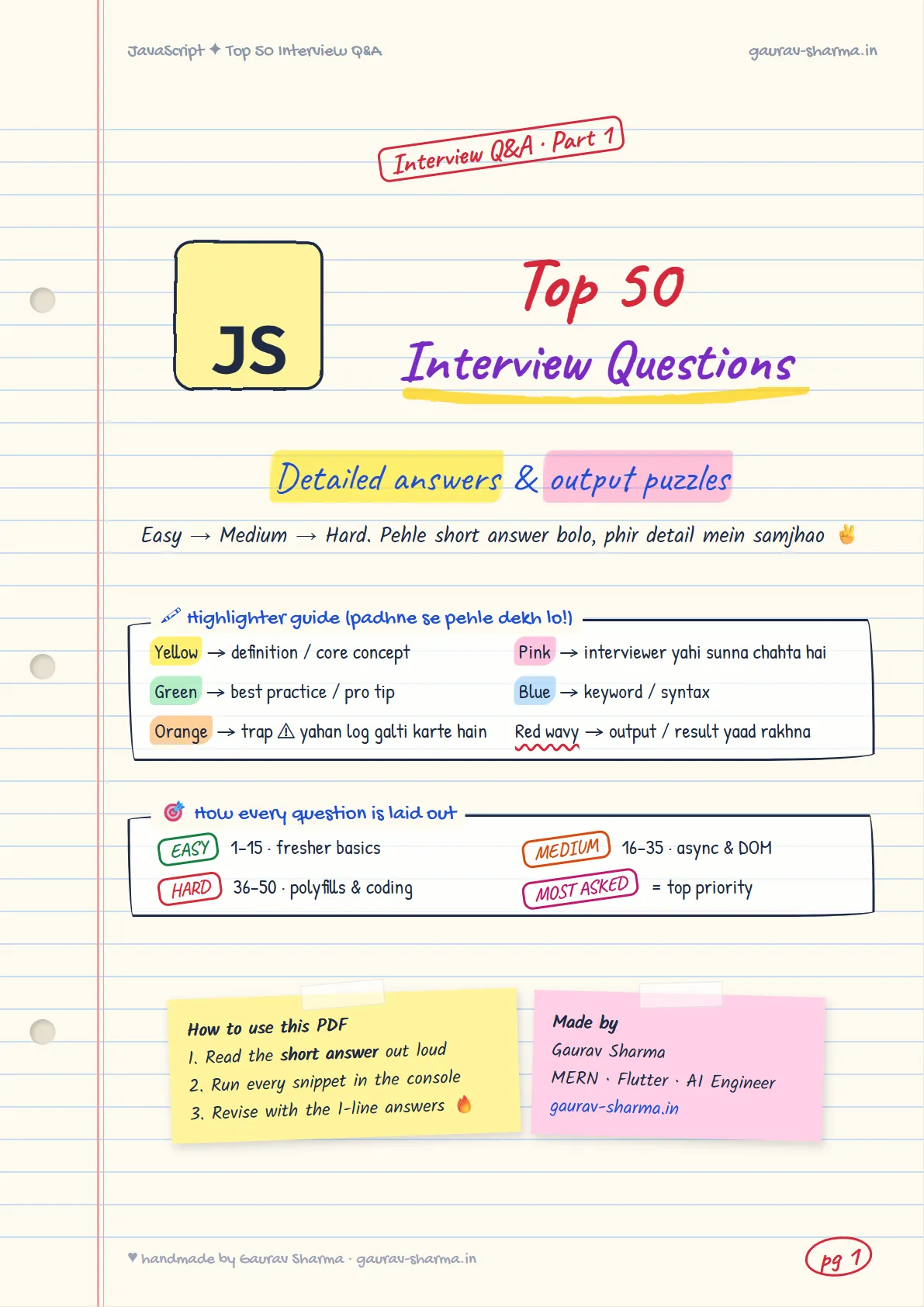
Interview questions · Part 1
Top 50 JavaScript Interview Questions with Answers (Free PDF)
49 pages covering the 50 most-asked JavaScript interview questions, each with a short answer to say first and a detailed explanation: var/let/const, hoisting, closures, this, the event loop and output puzzles, promises and async/await, plus coding answers for debounce, throttle, deep clone, Promise.all, bind, curry, memoize and an LRU cache, with Hinglish explanations.
- 49 pages
- English + Hinglish
- Free by email
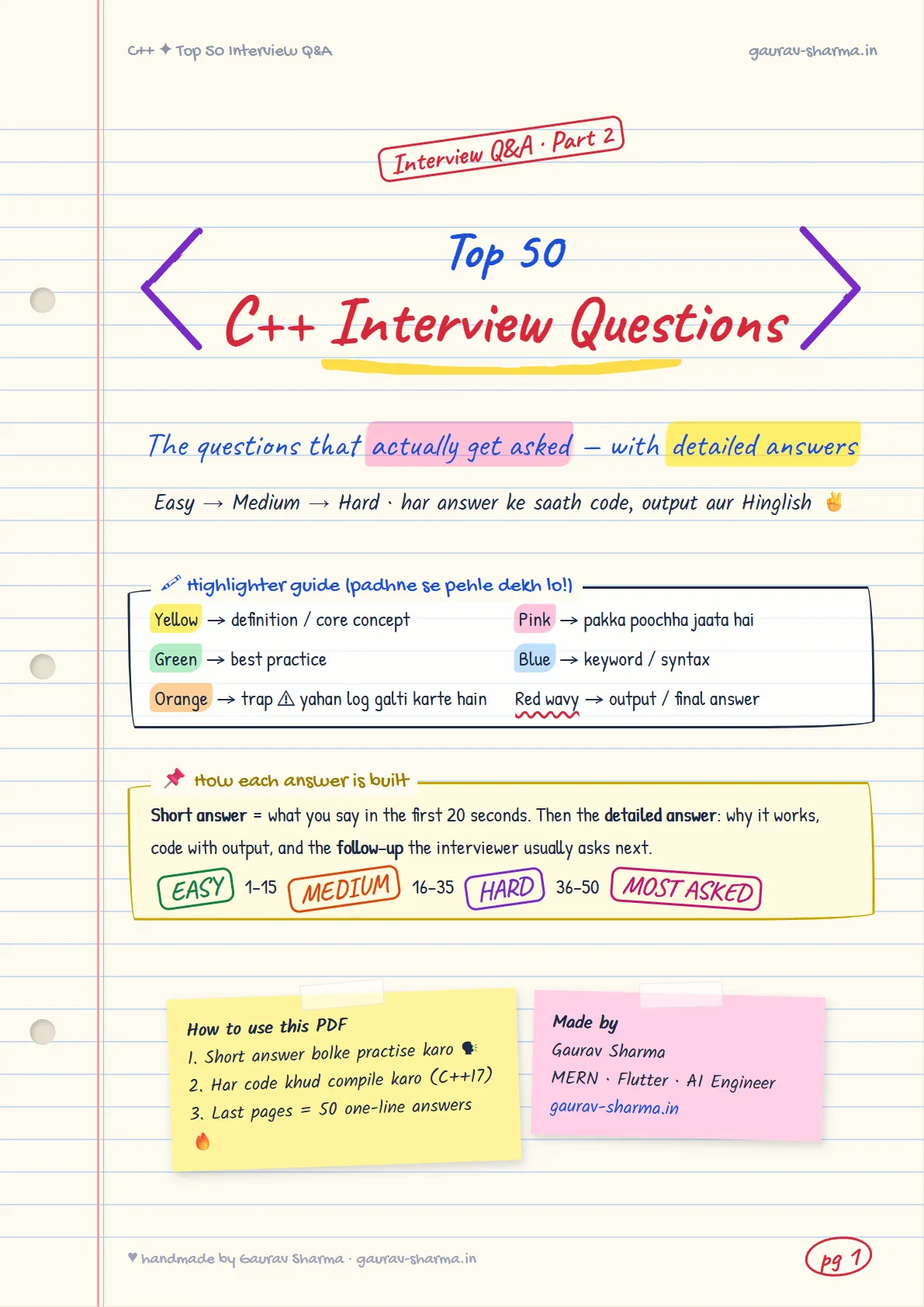
Interview questions · Part 2
Top 50 C++ Interview Questions with Answers (Free PDF)
56 pages covering the 50 most-asked C++ interview questions, each with a short answer to say first and a detailed answer with code, output and follow-ups: OOP, pointers vs references, virtual functions and vtable, virtual destructors, Rule of 3/5/0, smart pointers, RAII, STL, move semantics, output questions and coding questions, with Hinglish explanations.
- 56 pages
- English + Hinglish
- Free by email
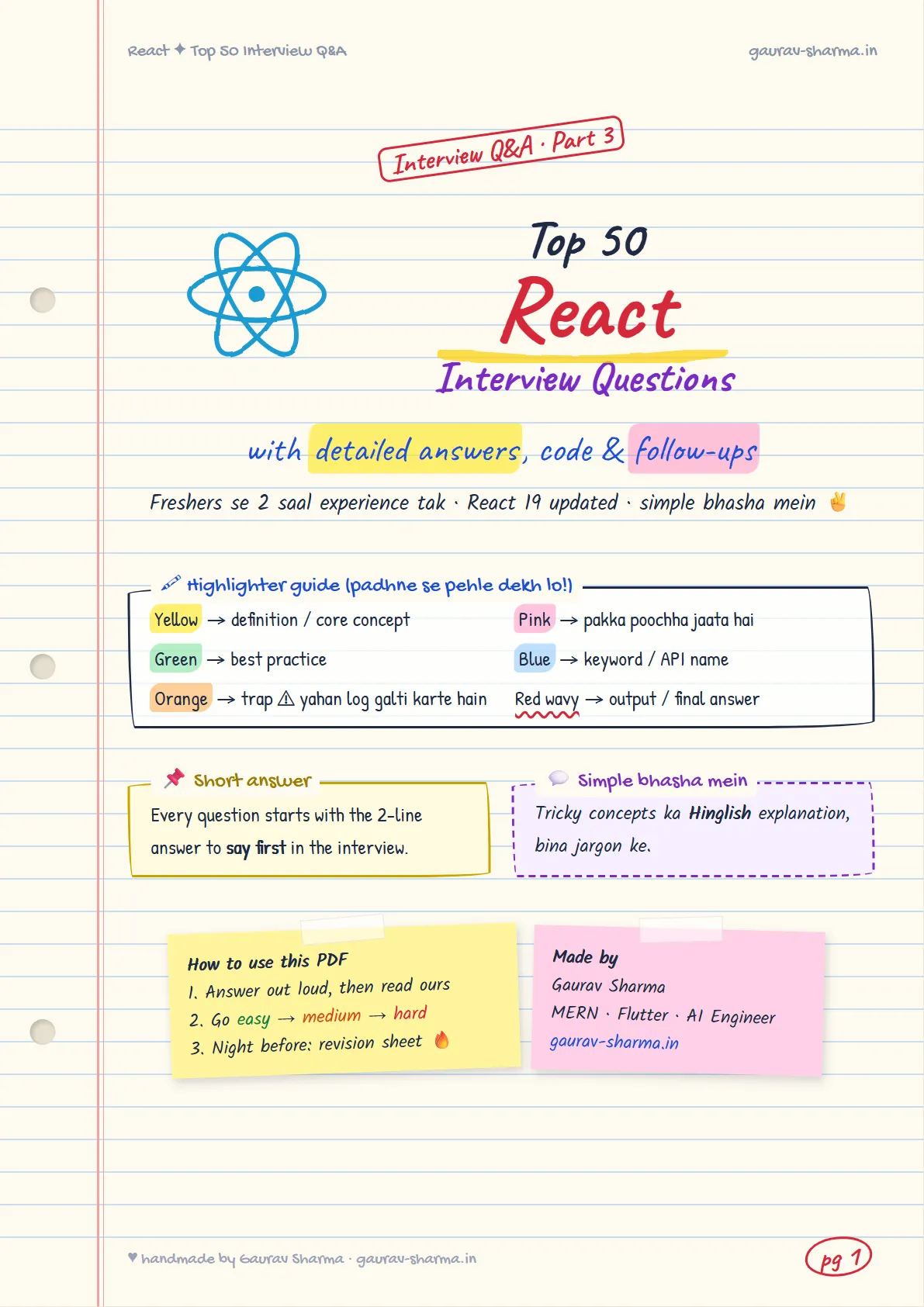
Interview questions · Part 3
Top 50 React Interview Questions with Answers (Free PDF)
The 50 most-asked React interview questions with detailed answers, for freshers and developers with up to 2 years of experience: virtual DOM, keys, props vs state, every common hook, re-renders, reconciliation, Fiber, concurrent rendering, React 19 Actions, Server Components, hydration, performance, testing and four coding questions, with code, diagrams and Hinglish explanations.
- 51 pages
- English + Hinglish
- Free by email
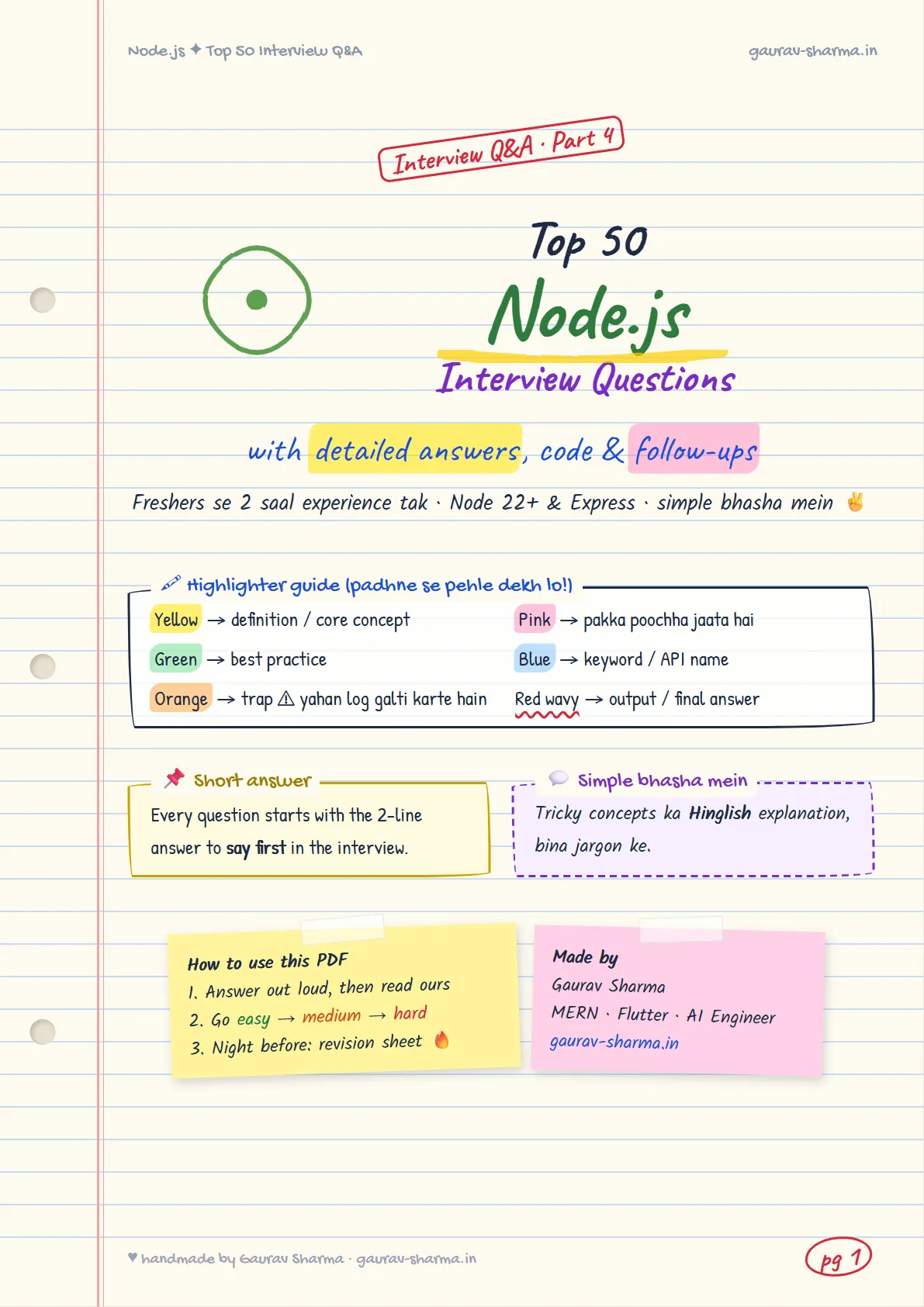
Interview questions · Part 4
Top 50 Node.js Interview Questions with Answers (Free PDF)
The 50 most-asked Node.js interview questions with detailed answers, for freshers and backend developers with up to 2 years of experience: the event loop, libuv, process.nextTick vs setImmediate, streams and backpressure, EventEmitter, cluster vs worker_threads vs child_process, Express middleware, JWT auth, Mongoose, graceful shutdown, testing, and coding and output-prediction questions, with code and Hinglish explanations.
- 61 pages
- English + Hinglish
- Free by email